Your cart is empty
Looks like you haven't added anything to your cart yet







Best Promotional Items for Government Agencies
Table of Contents
-
Top Promotional Items for Government Agencies
- 1. Custom Branded Pens and Office Essentials
- 2. Reusable Tote Bags for Community Outreach
- 3. Custom Drinkware and Water Bottles
- 4. Safety Kits and Educational Giveaways
- 5. Custom Apparel and Staff Uniforms
- 6. Challenge Coins and Lapel Pins for Recognition
- 7. Tech Accessories and Gadgets
- 8. Eco-Friendly Notebooks and Recycled Products
- GSA Compliant Promotional Products: What Buyers Need to Know
- Promotional Item Procurement Guidelines for Government Buyers
- Government Agency Branding Best Practices That Build Public Trust
- Sustainability and Eco-Friendly Mandates in Government Procurement
- How to Choose the Best Promotional Items for Government Agencies
- Conclusion
Last Updated: August 21, 2026
Top Promotional Items for Government Agencies
Procurement officers at government agencies face a unique challenge: every dollar spent on branded merchandise is a public dollar, subject to ethics rules, sustainability mandates, and procurement compliance. The best promotional items are tools for citizen engagement, staff recognition, and community outreach that must hold up to scrutiny on cost, quality, and purpose.
At 2mepromo.com, we work directly with government procurement teams to source and customize items that meet those standards. This guide breaks down the top product categories, compliance considerations, and what separates a smart government purchase from one that creates headaches later.
Quick Picks for Government Buyers:
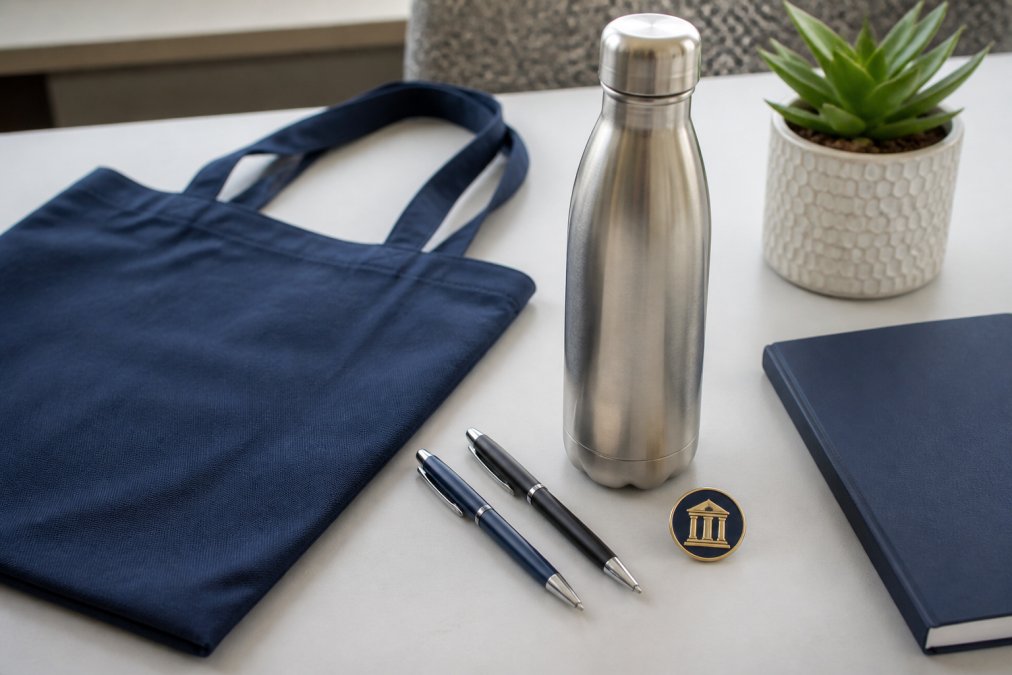
- Best everyday giveaway: Custom branded pens, highest distribution volume, lowest cost per impression
- Best for community events: Reusable tote bags, eco-friendly, high visibility, aligns with sustainability mandates
- Best for recognition: Challenge coins and lapel pins, high perceived value, lasting impact
- Best for public health outreach: Safety and first aid kits, practical, demonstrates community care
- Best for sustainability goals: Recycled notebooks and eco-friendly drinkware
1. Custom Branded Pens and Office Essentials
Custom pens remain the single most distributed promotional item across government agencies. They are genuinely useful, inexpensive in bulk, and carry your agency's logo into daily life on desks and at public counters.
The SKILCRAFT U.S. Government Pen is a benchmark in this category. It is retractable, refillable, and engineered to write continuously for one mile. It performs in temperatures from -40°F to 160°F, making it appropriate for field operations and office use. Crucially, SKILCRAFT pens are manufactured through the AbilityOne Program, which employs people who are blind, adding a social responsibility dimension that aligns with agency procurement priorities.
Pro Tip
Order pens with a refillable brass cartridge design. Refillable pens cost more upfront but reduce waste and align with federal sustainability goals, which matters when justifying purchases to oversight bodies.
2. Reusable Tote Bags for Community Outreach
Few promotional items match the public visibility of a reusable tote bag. Carried to farmers markets, libraries, and community events, a well-branded tote becomes a mobile billboard for your agency's outreach efforts.
Custom woven polypropylene tote bags offer full-bleed printing across all surfaces, giving maximum logo placement and messaging space. Eco-friendly inks and laminated woven construction ensure durability for years of regular use. Plan for high minimum order quantities and 60-90 day production lead times. Build this into your event planning calendar.
3. Custom Drinkware and Water Bottles
Branded drinkware is one of the highest-retention promotional categories. A quality water bottle or insulated tumbler stays with the recipient for years, generating consistent impressions at community events and public hearings.
Custom water bottles with weatherproof labels that resist peeling and fading are practical for large-scale government events. Stainless steel and BPA-free plastic options align with public health messaging and environmental stewardship.
4. Safety Kits and Educational Giveaways
Safety kits are among the most defensible promotional expenditures a government agency can make. They demonstrate direct public benefit, which simplifies the ethics review process for allowable use of agency funds.
Compact, branded first aid kits are a staple for public health departments and emergency management offices. Customized with your agency's logo and emergency contact information, the kit becomes both a safety tool and an ongoing branding asset.
Key Takeaway
Safety and educational giveaways are the easiest promotional items to justify under government ethics rules because they serve a direct public benefit. Lead with these when facing internal scrutiny on promotional spending.
5. Custom Apparel and Staff Uniforms
Branded staff apparel creates a professional, unified appearance at public events and functions as ongoing promotional exposure. A well-designed polo shirt or jacket worn at a community fair reaches hundreds of constituents in a single afternoon.
For government agencies, custom apparel typically includes polo shirts, fleece jackets, vests, and hats. Embroidery holds up better than screen printing for items that will be washed repeatedly, making it the preferred method for staff uniforms.
6. Challenge Coins and Lapel Pins for Recognition
Recognition items carry weight and are not meant for mass distribution. Custom challenge coins are deeply embedded in military and government culture, distributed at ceremonies and veteran programs as enduring mementos of service and achievement. A well-crafted challenge coin carries the agency seal or commemorative design and is kept for decades. Lapel pins serve a similar function at smaller scale, with high perceived value at relatively low per-unit cost.
7. Tech Accessories and Gadgets
Tech accessories have become practical staples in government promotional programs, particularly for agencies targeting younger constituents. Custom USB drives, phone stands, screen cleaning kits, and branded charging cables are genuinely useful items that recipients keep and use regularly.
Specify quality minimums in your purchase order and request samples before committing to a bulk run.
8. Eco-Friendly Notebooks and Recycled Products
Recycled notebooks and journals align with federal sustainability directives while remaining genuinely useful. Options include notebooks made from recycled paper with cork or grass covers, available with pen loops and custom branding. According to the U.S. General Services Administration's sustainable procurement guidance, federal agencies are encouraged to prioritize products with recycled content and environmentally preferable attributes.
| Item | Best Use | Key Consideration |
|---|---|---|
| Custom pens | Daily giveaways, public counters | Choose refillable for sustainability |
| Reusable tote bags | Community events, outreach | Plan for 60-90 day lead times |
| Branded drinkware | Public events, awareness campaigns | Prioritize BPA-free, durable materials |
| Safety/first aid kits | Public health programs, events | Easiest to justify under ethics rules |
| Custom apparel | Staff uniforms, public-facing events | Embroidery over screen print for longevity |
| Challenge coins | Recognition, ceremonies | High perceived value, not for mass distribution |
| Tech accessories | Conferences, younger audiences | Request samples before bulk ordering |
| Recycled notebooks | Conferences, internal use | Aligns with sustainability mandates |
GSA Compliant Promotional Products: What Buyers Need to Know
Government agencies purchasing promotional products through official channels have specific procurement frameworks to follow. Understanding these frameworks upfront prevents delays, audit findings, and vendor disputes.
GSA Schedule Purchasing and Tax-Exempt Procurement
GSA Schedule purchasing is the federal government's preferred contracting vehicle for acquiring commercial products at pre-negotiated prices. Vendors on the GSA Schedule have already passed vetting requirements, which simplifies the procurement process for agency buyers.
For promotional products, GSA Schedule purchasing means agencies can order branded merchandise from pre-approved vendors without running a full competitive bid. The GSA Advantage online purchasing platform maintains a searchable catalog of Schedule-approved vendors and products, making it a practical starting point for any government promotional purchase.
508 Compliance and Accessibility in Promotional Design
Section 508 compliance refers to the federal requirement under the Rehabilitation Act that electronic and information technology be accessible to people with disabilities. For promotional items, this principle extends to design: printed materials, QR codes, and digital assets should follow accessibility standards.
In practice, this means using high-contrast color combinations, readable font sizes, and avoiding design elements that rely solely on color to convey information. For branded educational handouts or safety guides, following Section 508 accessibility standards is a legal requirement for federal agencies.
Promotional Item Procurement Guidelines for Government Buyers
Smart procurement starts before the purchase order. The rules governing what government agencies can buy, from whom, and for what purpose are specific.
Ethics Rules and Allowable Use of Agency Funds
Government ethics rules restrict the use of agency funds for items that primarily benefit individual employees rather than serve a public purpose. Promotional items generally pass this test when used for public outreach, citizen engagement, community events, or official recognition programs.
The key requirement: agencies should articulate the public benefit of any promotional purchase. "Branded items for distribution at the annual public safety fair" is defensible; "staff morale" alone is not. Consult your agency's ethics officer or general counsel before purchasing items for internal distribution.
Bulk Ordering, Lead Times, and Vendor Vetting
Bulk ordering is standard for government promotional purchases, but it introduces planning requirements that agencies often underestimate. Custom production takes time. A realistic timeline for most custom promotional items runs three to six weeks from artwork approval, longer for complex items like embroidered apparel or custom challenge coins.
Vendor vetting should include reviewing samples, confirming production capabilities, and verifying that the vendor can provide required documentation (W-9, proof of insurance, business registration).
Watch Out
Do not approve artwork for a bulk government order without reviewing a physical or digital proof. Catching issues before production saves significant time and budget.
Government Agency Branding Best Practices That Build Public Trust
Effective branding for government agencies is about looking trustworthy and approachable. The promotional items your agency distributes are a direct extension of that brand.
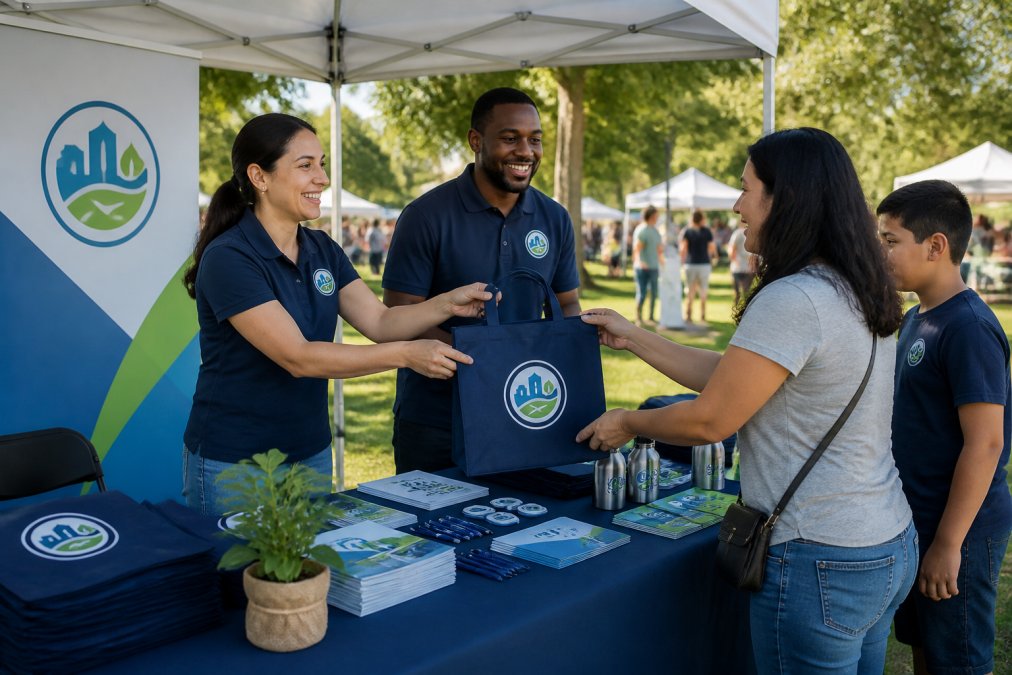
Consistency is the foundation. Every branded item should use the same logo version, color values, and typography. Inconsistent branding signals disorganization, which erodes public confidence. Establish a brand style guide and require all vendors to work from approved artwork files.
Utility drives retention. The best promotional items are the ones that recipients actually keep and use. Prioritize quality over quantity: fewer, better items outperform large volumes of forgettable giveaways.
Sustainability and Eco-Friendly Mandates in Government Procurement
Federal and state sustainability mandates have moved from aspirational guidance to procurement requirements. Executive Order 14057 directed federal agencies to prioritize sustainable purchasing, including products made from recycled or environmentally preferable materials.
For promotional products, this means actively seeking items with recycled content, avoiding single-use plastics where reusable alternatives exist, and selecting vendors who can document their environmental practices. Recycled notebooks, reusable tote bags, stainless steel drinkware, and refillable pens all fit within this framework.
Include sustainability criteria in your vendor evaluation rubric. Ask vendors to specify recycled content percentage and confirm whether inks and coatings meet environmental standards.
How to Choose the Best Promotional Items for Government Agencies
Choosing the best promotional items comes down to four criteria: public purpose, compliance fit, quality, and budget transparency.
Start with purpose. What is this item supposed to accomplish? Community outreach items should be high-visibility and broadly useful. Recognition items should carry weight and durability.
Check compliance first. Confirm that the purchase fits within your agency's ethics guidelines and that the vendor meets procurement requirements. For federal agencies, GSA Schedule vendors simplify this step.
Demand samples. No government buyer should commit to a bulk order without reviewing a physical sample or detailed digital proof. Quality variation across vendors is significant.
Plan lead times realistically. Build at least four to six weeks into your timeline from artwork approval to delivery. For complex items or large quantities, eight weeks is more prudent.
A checklist for government promotional procurement:
- Documented public purpose for the purchase
- Ethics officer or general counsel review completed
- Vendor verified against GSA Schedule or agency-approved vendor list
- Sustainability criteria evaluated and documented
- 508 accessibility considerations applied to printed materials
- Physical or digital proof reviewed and approved before production
- Realistic lead time confirmed with vendor
- Bulk pricing and total cost documented for procurement file
| Procurement Step | Action Required | Who Is Responsible |
|---|---|---|
| Purpose documentation | Write public benefit statement | Requesting department |
| Ethics review | Consult ethics officer or counsel | Procurement officer |
| Vendor vetting | Verify GSA Schedule or approved list | Procurement officer |
| Sustainability check | Request recycled content documentation | Procurement officer |
| Artwork approval | Review proof before production | Department head + vendor |
| Lead time confirmation | Get written delivery commitment | Procurement officer |
The best promotional items for government agencies serve a clear public purpose, survive the procurement process without complications, and reflect well on the agency long after the event ends. That standard is achievable with the right vendor relationship and a disciplined procurement approach.
Sourcing promotional products for a government agency involves more moving parts than most vendors acknowledge. Compliance requirements, sustainability mandates, ethics rules, and quality standards all have to align before a single item ships. 2mepromo.com specializes in exactly this kind of coordinated procurement, from custom apparel and branded signage to recognition items and event materials. Our team manages artwork preparation, bulk ordering logistics, and vendor documentation so your procurement office has what it needs. Get started with 2mepromo.com and receive branded merchandise that meets your agency's standards and holds up in the field.
Frequently Asked Questions
Are there specific regulations for purchasing promotional items for government use?
Yes. Government agencies must ensure promotional product purchases qualify as an official activity expense under applicable appropriations law. Items must serve a clear public awareness or outreach purpose, and agency funds cannot be used for purely personal gifts. Purchases often run through GSA Schedule contracts to ensure competitive pricing and compliance. Consulting your agency's legal counsel or contracting officer before placing bulk orders is the safest approach.
What is a good promotional gift for a government official that complies with ethics rules?
Practical, low-cost branded items work best within federal and state ethics guidelines. Custom pens, lapel pins, challenge coins, and branded notebooks are all commonly used because they carry clear institutional meaning and stay well under gift value thresholds set by the U.S. Office of Government Ethics. Items tied to a specific event, program, or commemorative occasion are easier to justify as official mementos rather than personal gifts.
How do government agencies select promotional products for public awareness campaigns?
Most agencies start by identifying the campaign goal, community outreach, safety education, or citizen engagement, then match the item's utility to that purpose. Procurement officers typically issue purchase orders through approved vendors on GSA Schedule or run competitive quotes for larger orders. Durability, logo placement quality, and lead times all factor into the decision. Eco-friendly and 508-accessible options are increasingly required under federal sustainability and accessibility mandates.
What are some unique promotional items for government events in 2026?
Beyond standard pens and tote bags, agencies are seeing strong engagement from custom challenge coins, branded first aid safety kits, and tech accessories like USB drives or wireless chargers with agency logos. Recycled notebooks with custom covers and reusable drinkware branded with public service messaging also stand out at community events. The best choices combine high daily utility with clear, durable logo placement so the item keeps reinforcing the agency's presence long after the event.
What makes a promotional item budget-friendly for a government agency?
Budget-friendly promotional products for government agencies balance a low cost-per-impression against a useful daily function. Items like branded pens, tote bags, and drinkware are distributed in large quantities, so the per-unit price drops significantly with bulk ordering. Pricing depends on quantity, customization complexity, and delivery timeline, so requesting quotes early and ordering through GSA Schedule contracts can help agencies stay within budget while meeting procurement requirements.
This article was written using GrandRanker
- Choosing a selection results in a full page refresh.
