Your cart is empty
Looks like you haven't added anything to your cart yet







Best Promotional Products for Trade Shows in 2026
Table of Contents
- Why the Best Promotional Products for Trade Shows Do More Than Fill Swag Bags
- How to Choose Promotional Products for Trade Shows: A Quick Comparison
- Trade Show Swag Ideas Under $1 Per Unit
- Useful Trade Show Giveaways Attendees Keep: Drinkware and Desk Items
- Branded Tech Giveaways for Trade Shows: Power and Portability
- Trade Show Booth Engagement Ideas That Turn Traffic Into Leads
- How to Measure Giveaway ROI and Post-Event Engagement
- Common Mistakes When Ordering Promotional Products for Trade Shows
- Frequently Asked Questions
Last Updated: October 5, 2026
Why the Best Promotional Products for Trade Shows Do More Than Fill Swag Bags
The best promotional products for trade shows are the ones attendees actually use after the event, not the ones that look impressive in a catalog.
Most trade show giveaways fail because they're chosen for novelty, not utility. A flashing keychain gets a laugh; a branded pen gets used for months.
This guide covers what works at each price point, how to match items to event goals, and how to measure returns.
How to Choose Promotional Products for Trade Shows: A Quick Comparison
Most exhibitors pick swag by browsing a catalog and guessing. Work backward from three variables instead: who receives the item, what you want them to do next, and cost per qualified lead.
Start With Attendee Personas, Not Product Categories
A single booth typically sees four distinct visitor types, each justifying a different giveaway tier:
| Visitor Type | What They Want | Right Giveaway Tier | Why |
|---|---|---|---|
| Drive-by scanner | Free stuff, no conversation | Under $1/unit | You are buying impressions, not leads |
| Curious browser | A reason to stop and look | $1-$5/unit | Low commitment, moderate recall |
| Qualified prospect | Proof you solve their problem | $15-$50/unit | Earned item signals value |
| Existing customer or partner | Recognition and relationship | $25-$75/unit | Retention matters more than acquisition |
Exhibitors typically over-invest in the drive-by tier and under-invest in the qualified tier, ending up with a booth full of pen-grabbers and an empty pipeline.
Match the Item to the Event Goal
Before you order anything, name the single goal for this show. Without one, you'll default to 'get more traffic', a hope, not a goal.
| Goal | Best Category | Price Tier | Typical Quantity |
|---|---|---|---|
| Maximum reach | Pens, drawstring bags | Under $1/unit | 200-500 |
| Daily brand recall | Drinkware, desk items | $15-25/unit | 50-100 |
| Qualified lead capture | Tech accessories | $20-50/unit | 25-75 |
| Booth visibility | Banners, counters, tents | $85-1,200/unit | 1-3 |
The logic: cheap items go to everyone, premium items go to people who stop and talk, and display hardware pulls the crowd in.

The Trade-Offs Nobody Puts in the Catalog
Every giveaway carries hidden costs beyond the unit price:
- Weight and shipping. 500 ceramic mugs weigh far more than 500 pens, costing more to ship and move. If you're flying, freight limits can erase per-unit savings.
- Setup and handling time. Items needing assembly, batteries, or pairing eat staff time. A power bank that must be charged first is a logistics problem, not a giveaway.
- Customization lead time. Printed pens and bags ship in days; custom electronics, apparel, and drinkware often need two to four weeks.
A Simple Decision Sequence
- Name the goal for this show (reach, recall, or qualified leads).
- Estimate how many of each visitor type you expect.
- Assign a giveaway tier to each type.
- Check weight, lead time, and setup burden against your logistics plan.
- Order display hardware first, then giveaways.
Pro Tip
Order your display hardware before your giveaways. A retractable banner or counter takes 2-3 business days to ship, and you don't want signage arriving after your pens.
Trade Show Swag Ideas Under $1 Per Unit
High-volume giveaways work when the item survives daily use. Pens and bags clear that bar; stress balls and foam fingers don't.
Custom Pens: 200 for $115
Our European-styled ballpoint click pen comes in matte blue, green, black, and red with silver accents and German black ink.
At roughly 58 cents per pen, this is the workhorse of trade show swag. People keep, lose, borrow, and hand off pens, spreading your logo without extra cost.
One caveat: all type must be at least 8pt, so keep your imprint simple. A cramped logo or tagline won't reproduce well at that size.
Full-Color Drawstring Bags: 150 for $675
These 210 denier polyester cinch packs measure 16.5" by 14.5" with adjustable drawcord straps. Full-color printing allows gradients and photos, not just a single ink color.
The strategic play most exhibitors miss: hand out the bag first, then let attendees fill it with your other giveaways.
At $4.50 per unit, it's not the cheapest option, but it multiplies every other item you hand out.
Useful Trade Show Giveaways Attendees Keep: Drinkware and Desk Items
Items that live on a desk or in a hand get seen every day. That repetition builds brand recall.
Branded Ceramic Mugs at $19.99
Our 11 oz ceramic mug with logo features a crisp logo print, a comfortable handle, and durable construction. It fits offices, client gifts, and employee recognition.
At this price point, mugs belong in your qualified-lead tier, not your general handout pile.
Pair drinkware with a desk accessory and you've built a small kit that sits in plain view during every workday.
Watch Out
Don't hand premium drinkware to everyone who walks by. Once it's a free-for-all, you've spent $20 per unit on people who never gave you a name or a badge scan.
Branded Tech Giveaways for Trade Shows: Power and Portability
Tech items command attention because they solve an immediate problem: a dying phone at a three-day conference.
Power banks, charging cables, and phone accessories fall here.
What separates a used tech giveaway from a tossed one? Practicality.
Order these early. Custom electronics often carry longer production windows than printed pens or bags, and a missed ship date means empty-handed attendees.
[Prime] Best Seller Retractable Banner Stand →
Trade Show Booth Engagement Ideas That Turn Traffic Into Leads
Your display hardware stops foot traffic; your staff converts that stop into a conversation.
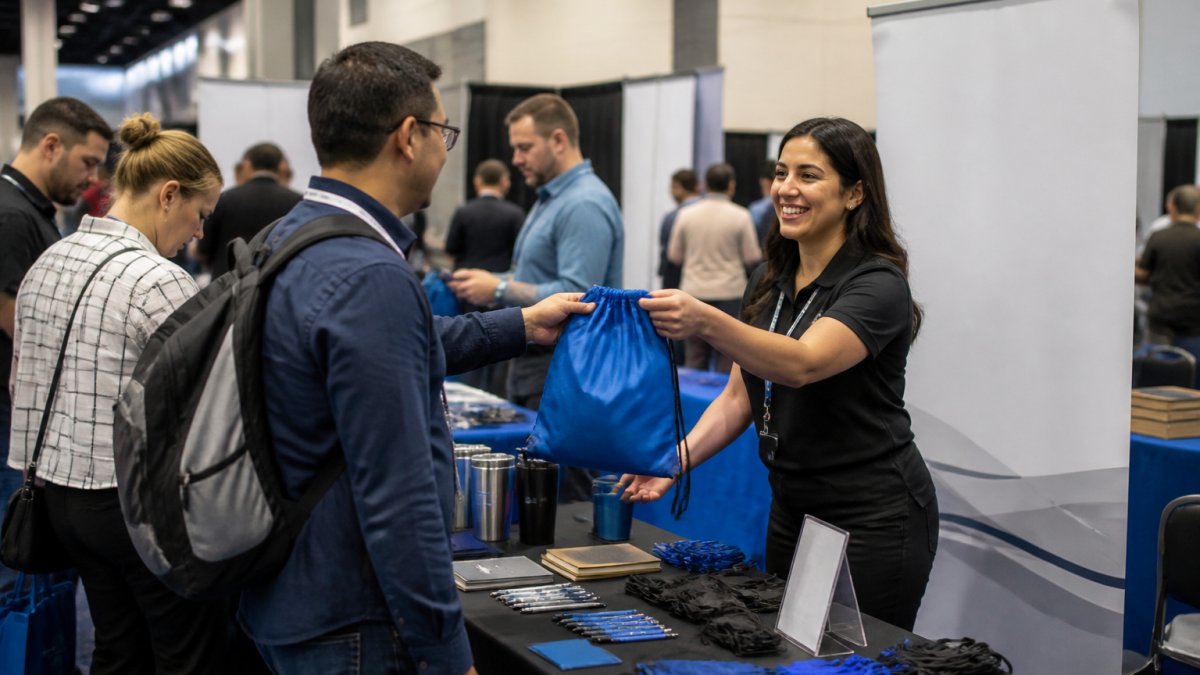
Booth Displays and Signage That Pull People In
A retractable banner stand starts at $95.38 and sets up in seconds, storing in its included padded travel bag.
For higher-traffic events, a pop-up counter at $428.81 gives you a surface for demos and a branded backdrop.

If your booth is outdoors, a 10ft custom canopy tent at $680.95 provides shade and a printed canopy top.
The engagement formula: display hardware creates visibility, a giveaway creates a reason to stop, and a qualifying question creates the lead.
Key Takeaway
Match your giveaway tier to your lead qualification. General handouts for foot traffic, premium items for qualified conversations.
How to Measure Giveaway ROI and Post-Event Engagement
Giveaway ROI equals the revenue from leads your swag helped capture, divided by your total promotional spend. That formula is easy to state and hard to execute, because most exhibitors never build tracking into the giveaway itself. They hand out 500 items, collect 80 badge scans, and have no idea which 80 came from which item.
Why Attendees Keep Some Swag and Toss the Rest
Before you can measure anything, it helps to understand what makes a promotional product survive the trip home. Three factors matter:
- Immediate utility. Items that solve a problem in the next 24 hours (a pen when theirs runs dry, a bag when their hands are full, a charger when their phone is dying) get kept. Items that solve a problem someday get tossed.
- Perceived value relative to effort. A premium item handed out freely feels cheap. The same item earned through a demo or a qualifying question feels valuable, and recipients treat it accordingly.
- Social visibility. Items used in front of other people (drinkware on a desk, a bag at the gym) generate repeated brand exposure. Items used in private generate one impression.
This is why the same $20 item can be a waste or an asset depending on how it is distributed. The distribution mechanic is part of the product decision.
Tracking Mechanics: How to Attribute a Lead to an Item
The only reliable way to connect a giveaway to a lead is to make the item itself trackable. A few approaches work:
- Unique QR codes per item type. Print a different QR code on pens, bags, and drinkware. Each code routes to a distinct landing page or UTM parameter, so you know which item they received.
- Short URLs with item-specific slugs. A short URL like yourdomain.com/pen or yourdomain.com/mug accomplishes the same attribution with less print complexity.
- Redemption codes. A unique code on high-value items (drinkware, tech) that unlocks a discount or resource gives you a measurable action tied to a specific giveaway.
The goal is not perfect attribution. It is directional attribution, enough signal to know which categories are pulling their weight.
The Metrics That Actually Matter
Track these after every event:
- Cost per qualified lead: total giveaway spend divided by leads captured. Compare across item categories, not just across shows.
- Badge scans vs. handouts: the ratio tells you how many people just wanted free stuff. A low ratio means your giveaway tier is misaligned with your qualification process.
- Follow-up response rate: how many leads replied to your post-event email. Segment by which item they received to see if premium items produce better engagement.
Post-Event Engagement Is the Real Test
A pen that generates a website visit three weeks later is worth more than a premium item that vanishes.
Reference the item in your follow-up. 'Thanks for picking up our mug at the show' is a warmer opener than a generic template, and it reinforces the brand impression the item was supposed to create.
Review results after each show and shift budget toward the categories that produce leads, not the ones that produce the most handshakes.
Key Takeaway
If you cannot trace a lead back to a specific giveaway category, you cannot improve your giveaway strategy. Build the tracking into the item before you order it.
Common Mistakes When Ordering Promotional Products for Trade Shows
The most expensive mistake is ordering giveaways before you've defined what a qualified lead looks like. Without that definition, every item gets handed out indiscriminately.
Watch for these pitfalls:
- Ordering too late. Custom printing and production take time. Rush orders cost more and limit your options.
- Ignoring artwork requirements. Files that look fine on screen can fail production. Send clean, print-ready artwork and review the proof carefully.
- Buying novelty over utility. If you can't picture someone using it next week, don't order 500 of them.
- Skipping the display budget. A great giveaway with no signage to draw people in wastes the giveaway.
- No follow-up plan. Leads go cold within days without a structured outreach sequence.
A common mistake is treating swag as a standalone purchase. It works best as one piece of a booth strategy that includes signage, staffing, and follow-up.
Choosing the right mix of giveaways, displays, and follow-up takes planning, and the details matter more than the budget. 2mepromo.com helps government agencies and small businesses build complete event kits, from custom retractable banner stands and canopy tents to branded pens, drawstring bags, and drinkware, all with personalized branding support.
![[Prime] Best Seller Retractable Banner Stand](https://cdn.shopify.com/s/files/1/0712/7492/2209/files/ONE-CHOICE-33.5-in-Good-Roll-Up-Banner-Stand-Graphic-Package_1.jpg?v=1785101936)
Frequently Asked Questions
What are the best promotional products to give away at trade shows?
The best promotional products for trade shows balance low cost per unit with daily usefulness. Custom pens at $115 for 200 units and full-color drawstring bags at $675 for 150 units cover the high-volume giveaway tier. For attendees you want to remember you, branded ceramic mugs at $19.99 and retractable banner stands at $95.38 anchor a booth display that keeps working after the event ends. Match the item to the attendee persona and your lead generation goal.
How do I choose the right trade show giveaways for my audience?
Start with what your target audience does daily. Government procurement officers and HR administrators keep desk items like custom pens and branded mugs. Event coordinators notice booth infrastructure such as a Gopher Pop Up Counter at $428.81 or a 10ft custom canopy tent at $680.95. Small business owners at conferences respond to items they can reuse, like drawstring bags. Order a small test batch first, track how many units leave your booth, then scale what moves.
How much should I budget per attendee for promotional products?
Split your budget into two tiers. For broad giveaways, custom pens work out to about $0.58 each at $115 for 200 units, and drawstring bags run about $4.50 each at $675 for 150 units. Reserve higher-cost items like the 11 oz logo mug at $19.99 or the Pop Up Podium at $86.15 for qualified leads and scheduled meetings. This keeps cost-per-impression low on the floor while protecting margin on high-value conversations.
How far in advance should I order custom promotional products before a trade show?
Most custom items ship within 2 to 5 business days after artwork approval, but you should still order three to four weeks before your event date. That buffer covers proof review, any artwork cleanup, and shipping transit. Custom canopy tents ship in 3 business days and retractable banner stands in 2 business days, but bulk apparel and multi-item orders take longer to consolidate. Confirm your ship date in writing and build in a week of slack.
How do I measure whether trade show giveaways actually worked?
Track three numbers: units handed out, qualified leads captured, and follow-up response rate within two weeks. Assign a unique QR code or landing page to each giveaway tier so you can see which items drive scans and signups. Compare cost-per-impression across items by dividing total spend by units distributed. A $115 pen order that generates 200 booth conversations often beats a premium item that sits untouched, so let the follow-up data decide what you reorder.
- Choosing a selection results in a full page refresh.
