Your cart is empty
Looks like you haven't added anything to your cart yet








Custom Event Signage for Conferences: 7 Types That Work
Table of Contents
- Custom Event Signage for Conferences: What to Buy First
- Conference Welcome Signs and Registration Displays
- Conference Wayfinding Signs That Move People
- Conference Stage Backdrops and Lightbox Displays
- Hanging Banners and Overhead Brand Visibility
- Retractable Banners, Counters, and Booth Displays
- Event Signage Design Tips for Readability and Brand
- Outdoor, Reusable, and Budget Planning Considerations
- Frequently Asked Questions
Last Updated: October 19, 2026
Custom Event Signage for Conferences: What to Buy First
Custom event signage for conferences is the set of printed and illuminated displays that guide attendees, brand the venue, and give sponsors visibility across a multi-day program. At 2mepromo.com, we build these pieces for government agencies and small businesses that need a professional presence without a full exhibit house. The practical answer to "what do I buy first" is simple: start with registration, then wayfinding, then stage and overhead branding. Everything else follows.
That order matters because attendees hit registration before anything else, and they hit a wrong turn before they see your booth. Below, we break down seven sign types in priority order, plus the design, accessibility, and budget decisions that keep a signage plan from becoming a pile of mismatched banners.
Key Takeaway
Buy in attendee order, not catalog order. Registration signs, wayfinding, then stage and overhead branding. A gorgeous backdrop behind a confusing lobby still produces lost attendees.
Conference Welcome Signs and Registration Displays
Welcome and registration signage is the first physical proof that an event is organized. It answers three questions in under five seconds: am I in the right place, where do I check in, and who is running this.
The workhorse here is a branded table setup. Put it on the check-in table and you have covered the single most photographed surface at most conferences.
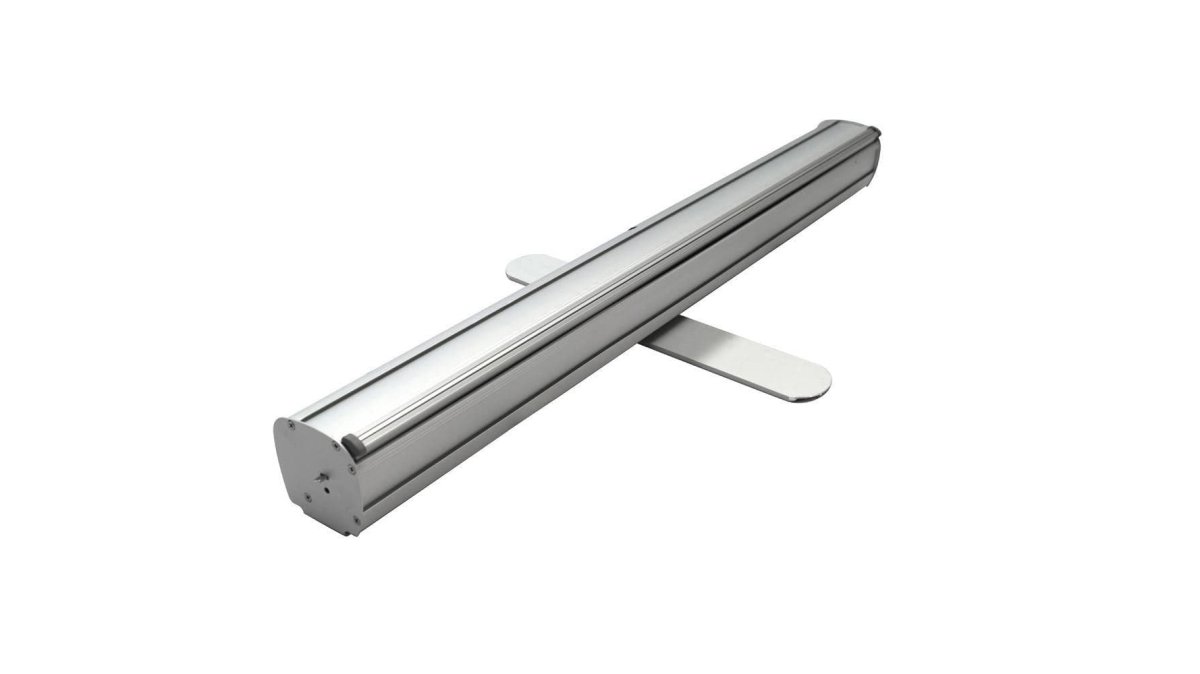
Pair it with a Portable Roll Up Banner at $123.30, which ships in 2 business days and carries a lifetime warranty on the stand. Set it beside the registration queue at roughly 33.5 inches wide by 80 inches tall, and attendees see your brand name from across the lobby.
A common mistake is printing the check-in sign with the event name only. Attendees already know the event name. They need the word "REGISTRATION" in letters big enough to read from 30 feet, plus a secondary line for badge pickup versus speaker check-in.
Conference Wayfinding Signs That Move People
Conference wayfinding signs are the directional layer of your signage plan: floor decals, freestanding directional signs, room markers, and overhead guides that move people from the lobby to the right hall without a volunteer repeating the same sentence 400 times. This is where most events underinvest, and it shows in the first coffee break.
Directional signage should follow the attendee journey, not the floor plan. Map the actual paths: entrance to registration, registration to main hall, main hall to breakout rooms, breakout rooms to restrooms and food. Then place a sign at every decision point where a person could plausibly turn the wrong way. Corners, elevator banks, and stair landings are the highest-value spots.
Accessibility belongs in this layer, not bolted on afterward. The ADA Standards for Accessible Design set requirements for accessible routes and signage, including character sizing and contrast rules for permanent room identification. Even for temporary event signs, following those contrast and letter-height conventions makes your wayfinding legible for low-vision attendees and anyone reading from a distance.
Watch Out
Directional signs mounted below eye level get missed in crowded halls. Attendees scan at roughly head height. If your only directional sign is a floor-standing A-frame behind a registration queue, people will walk past it and ask a volunteer instead.
Conference Stage Backdrops and Lightbox Displays
Stage backdrops carry the highest visual weight per square foot of any sign you will buy. Every photo from the keynote includes them, and they set the color temperature of the whole room. Two formats do most of the work.
Smooth Wall Fabric Graphic Panels start at $219.20 and come in widths from 10 to 40 feet at 8 or 10 foot heights, with perimeter hemming and grommets every 12 inches. Dye-sublimation printing keeps color saturated and resistant to fading. For a keynote wall, this is the cleanest large-format option: wrinkle-resistant, quick to hang, and easy to change between sessions.

For a smaller footprint with real presence, the 3.3 x 8ft SEGO Modular Lightbox Display runs $1,166.15. It uses a 120mm silver anodized aluminum frame with LED strips top and bottom, backlighting a silicone edge graphic. The modular frame connects to other SEGO units, so you can build a wider wall as the budget allows. Assembled dimensions are 39.4 inches wide by 94.5 inches high by 16.5 inches deep, and a travel bag is included.
Pro Tip
Order your stage backdrop before your printed program. Fabric backdrops photograph differently under stage lighting than they do on a monitor, and the dye-sublimation output on our panels reads slightly deeper than a screen proof. Confirm the physical sample against your stage lighting plan, not just a PDF.
Hanging Banners and Overhead Brand Visibility
Hanging banners solve a problem no floor-level sign can: they are visible above the crowd. In a hall with 2,000 people, eye-level signage disappears. Overhead signage does not.
The 8ft Hanging Banner Flat Panels start at $298.66 and the 10ft Hanging Banner Flat Panels at $658.97. Both use 30mm aluminum tubing with push spring button assembly, so setup needs no tools. Graphics are double-sided dye-sublimated fabric with an integrated blockout, which means the print reads correctly from both directions instead of showing through reversed. Hanging hardware and a travel bag come with each.

Two practical notes. First, confirm ceiling height and rigging points with the venue before you order, because a 10ft banner hung in a room with a low drop ceiling becomes a hazard rather than a landmark. Second, check the venue's rigging rules. Many convention centers require licensed riggers for overhead suspension, and that cost belongs in your budget line, not in a surprise invoice.
Retractable Banners, Counters, and Booth Displays
Booth and display graphics are the reusable core of your signage kit. These are the pieces you ship event to event, so durability and packability matter more than novelty.
The Silverwing Retractable Banner Stand Double-Sided at $236.00 ships in 2 business days and includes the printed graphic, silver base, top cross bar, adjustable support pole, and travel bag. Graphic heights run 69, 80, or 92 inches. Note one limitation honestly: the graphic is not changeable on this model, so commit to a design that will hold for a full season.
10 foot pop up back lit display →
For a check-in or sponsor station, the Qseg Cubic Counter at $567.69 gives you a 39.4 by 39.4 inch counter with four dye-sublimated SEG fabric graphics, a white laminate MDF top rated to 30 lbs, a removable inner shelf, and a wheeled travel bag. Tool-free latch assembly means one person can set it up.
If you need a lit centerpiece, the 10 foot pop up back lit display at $2,200.00 assembles to 117.3 inches wide by 87.8 inches high by 15 inches deep, with interior LED lighting behind 6 oz. premium backlit fabric on an aluminum frame.
| Display | Starting Price | Best For | Setup Notes |
|---|---|---|---|
| Portable Roll Up Banner | $123.30 | Registration queue, entry points | Ships 2 business days, lifetime stand warranty |
| Full Color Custom Table Throw | $179.00 | Check-in and sponsor tables | 4ft, 6ft, 8ft sizes, 1-day graphic turnaround |
| Silverwing Retractable Banner | $236.00 | Booth backwall, general use | Fixed graphic, 3 height options |
| 8ft Hanging Banner Flat Panel | $298.66 | Overhead hall visibility | Tool-free, double-sided, hardware included |
| Qseg Cubic Counter | $567.69 | Check-in, sponsor stations | Tool-free latch, wheeled bag |
| 10ft Hanging Banner Flat Panel | $658.97 | Large halls, high ceilings | Rigging required, check venue rules |
| SEGO Modular Lightbox | $1,166.15 | Lit booth centerpiece | Modular, connects to other frames |
| 10ft Pop Up Backlit Display | $2,200.00 | High-impact booth backwall | Interior LED, blackout fabric included |
Event Signage Design Tips for Readability and Brand
Event signage design tips usually devolve into color theory. The useful version is narrower: readability first, brand second, decoration never. A sign that cannot be read from its intended distance has failed regardless of how well it matches your brand guide.
Start with a distance rule. A rough working standard is one inch of capital letter height for every 10 feet of viewing distance. A sign read from 30 feet needs roughly 3-inch capitals; a directional sign read from 60 feet needs about 6 inches. Apply that before you fall in love with a typeface.
Then lock the system:
- Two typefaces maximum. One for headlines, one for body. Sans-serif for anything read at a distance.
- High contrast pairs. Dark text on light ground or the reverse. Avoid mid-tone on mid-tone.
- One accent color carried across every sign in the set, so attendees unconsciously link your directional signs to your booth.
- Consistent iconography for restrooms, food, and session rooms, so the same symbol appears at every decision point.
- Logo placement in the same corner on every piece, so the set reads as one system rather than seven separate orders.
Pro Tip
Print a paper proof at 25% scale and tape it to a wall. Step back to the distance you expect attendees to read from, then halve that distance and look again. Type that seems oversized on a monitor usually reads correctly in a hall, and type that looks "just right" on screen is almost always too small.
For artwork files, ask about proofing before production. If your files came from an old designer and nobody in-house preps print artwork, send what you have and let the production team flag resolution and bleed issues early rather than after the run.
Outdoor, Reusable, and Budget Planning Considerations
Outdoor signage and reuse planning are where conference budgets quietly succeed or fail. Two decisions drive most of the total cost of ownership: how much of the kit survives to the next event, and how much of it can go outside.
On reuse, the math is straightforward. A retractable stand with a lifetime warranty, a counter with replaceable SEG graphics, and a hanging banner that packs into its own travel bag all spread their cost across multiple events. Single-use foam board does not.

Budget planning should also account for the costs that never appear on a product page:
- Rigging and labor at venues that require licensed installers for overhead suspension
- Shipping and drayage, which convention centers often bill separately from freight arrival
- Storage between events, especially for large fabric walls and counters
- Graphic refresh cycles, typically annual for brands that update campaigns frequently
On sustainability, reuse is the lever that matters most. Hardware that survives multiple events and graphics that swap without replacing the frame keep material out of the waste stream, and they keep the line item out of next year's budget.
If you are planning a conference and want the whole kit specified in one place, 2mepromo.com handles signage, custom apparel, and event displays together, with tailored solutions for government agencies and small businesses.
The hard part of conference signage is not choosing a banner.
Frequently Asked Questions
What types of signs are useful at a conference?
Most conferences need four sign groups: welcome and registration signs at the entrance, wayfinding signs at every decision point, booth and display graphics in the exhibit hall, and stage backdrops behind speakers. A 10ft hanging banner flat panel at $658.97 covers overhead visibility, while a portable roll up banner at $123.30 handles smaller check-in points. Match the sign to the moment the attendee needs it rather than buying one format for everything.
How do you make conference signage easy to read?
Keep the type large, the contrast high, and the message short. A welcome sign should carry the event name, a directional arrow, and nothing else competing for attention. Place signs at eye level or above head height so a crowd cannot block them, and repeat the same color scheme and fonts across every piece. Dye-sublimated fabric graphics hold color well, so a full-color print stays legible under convention center lighting.
What signage helps attendees find their way around an event?
Conference wayfinding signs work best when they repeat at each decision point: elevator banks, hallway junctions, and room entrances. Use one consistent arrow style and room naming convention. Directional signs should sit at or slightly above eye level, and overhead hanging banners help in large halls with high ceilings. Pair a wayfinding sign with the session name, not just a room number, so attendees confirm they are in the right place.
How can conference signs be reused at future events?
Choose hardware with changeable graphics where possible. The Qseg Cubic Counter at $567.69 uses silicone edge graphics that swap out in minutes, and the SEGO modular lightbox display can connect with other frames to fit a new floor plan. Store frames in their included travel bags and keep a shared file of approved artwork. Reusable hardware cuts the cost per event, and a lifetime stand warranty on the portable roll up banner protects the investment.
- Choosing a selection results in a full page refresh.
