Your cart is empty
Looks like you haven't added anything to your cart yet







How to Choose Quality Custom Apparel: 2026 Guide
Table of Contents
- Start With the End Use: Matching Custom Apparel to Its Job
- Pick the Best Fabric for Custom T-Shirts and Polos
- Read the Construction: Stitching, Seams, and Fit
- Screen Printing vs. Embroidery Durability (and Where DTF Fits)
- Sample Testing and Care: How to Verify Quality Before Bulk Ordering
- Plan for Lead Times, Sustainability, and Post-Production Care
- Conclusion: A Practical Checklist for Choosing Quality Custom Apparel
- Frequently Asked Questions
Last Updated: October 6, 2026
Start With the End Use: Matching Custom Apparel to Its Job
Quality begins with purpose. Custom apparel is clothing decorated with your logo, name, or message for a specific use: staff uniforms, event giveaways, or branded merchandise.
This guide from 2mepromo.com covers fabric, construction, decoration, and sampling.
The FTC's guidance on textile labeling requires accurate fiber content and care disclosure on garments sold in the U.S., so the tag on any sample you receive is a legal document, not marketing copy.
Uniforms, Giveaways, and Event Wear Need Different Specs
Uniforms take repeated industrial washing and daily wear, so prioritize durable fabric and stitched decoration. Giveaways trade longevity for cost, making a lighter ring-spun cotton tee a sensible default. Event wear sits between the two: sharp in photos, but only needs to survive a weekend.
- Uniforms: heavier fabric, embroidery, reinforced seams
- Giveaways: lighter cotton, screen printing, one-size-fits-most sizing
- Event wear: mid-weight fabric, bold print coverage, fast turnaround
When High-Visibility Standards Apply
Safety-critical roles require garments meeting recognized high-visibility standards for background color and reflective elements. Ask your supplier to confirm compliance in writing.
Pick the Best Fabric for Custom T-Shirts and Polos
Fabric weight and fiber content decide how a garment feels, prints, and lasts. Weight is measured in GSM (grams per square meter); heavier weights drape better and hold shape longer, while lighter weights feel cooler and cost less.
For the best fabric for custom t-shirts, match weight to use. A 4.5-5.5 oz (roughly 150-185 GSM) ring-spun cotton works for giveaways. Step up to 6 oz or heavier for uniforms that face weekly washing.
Natural vs. Synthetic Fibers: What Each One Does Well
Natural fibers like cotton breathe well, take screen printing cleanly, and feel soft. Synthetic blends resist shrinking, dry faster, and hold color through repeated washing, making them strong for performance wear.
Most promotional apparel uses a blend for a reason: cotton for comfort, polyester for durability. Ask for both a 100% cotton and a 50/50 sample before committing to bulk.
| Fiber | Best For | Trade-Off |
|---|---|---|
| 100% ring-spun cotton | Giveaways, retail-fit tees | Shrinks slightly, wrinkles |
| 50/50 cotton/poly | Uniforms, frequent washing | Less breathable |
| Polyester performance | Moisture-wicking, athletics | Prints feel stiffer |
| Tri-blend | Soft retail feel, fashion cuts | Higher cost per unit |
Read the Construction: Stitching, Seams, and Fit
Construction quality shows up in places buyers rarely check until it is too late.
Run your thumb along the shoulder and side seams of any sample. Double-needle stitching and taped neck and shoulders signal a garment built to hold its shape.
Fit matters just as much. Retail-fit garments follow standard sizing; classic fit runs roomier. Ask for a size chart and confirm sizing consistency across colors, since dye lots and cut patterns vary between runs.
Screen Printing vs. Embroidery Durability (and Where DTF Fits)
Decoration method determines how long your branding survives. Screen printing lays ink on the fabric surface: affordable for large runs, but vulnerable to cracking if the ink is thin or the cure rushed.
Direct-to-film (DTF) printing sits between them: it transfers a printed film onto fabric, handling full-color, photographic logos screen printing cannot reproduce economically. DTF works well on cotton and cotton blends, though vibrancy depends on fabric preparation.
| Method | Durability | Best For | Detail Limit |
|---|---|---|---|
| Screen printing | Moderate | Bulk tees, bold logos | 1-4 spot colors |
| Embroidery | Highest | Polos, hats, uniforms | Simple, clean logos |
| DTF | Good | Full-color, photo logos | Unlimited colors |
Custom Logo Embroidery: When Stitched Branding Wins
Custom logo embroidery is the right call when a garment will be worn repeatedly and the logo must look professional up close. Stitched logos resist fading and peeling, ideal for staff apparel and recognition gifts.
The trade-off is detail. Fine text and gradients do not stitch cleanly, so simplify the artwork to bold shapes and readable type before production.
Pro Tip
Ask for a digitized stitch-out of your logo before approving a bulk embroidery order. A flat vector file and a stitched result look different, and a stitch-out catches problems like dropped letters or a distorted curve while changes are still free.
Sample Testing and Care: How to Verify Quality Before Bulk Ordering
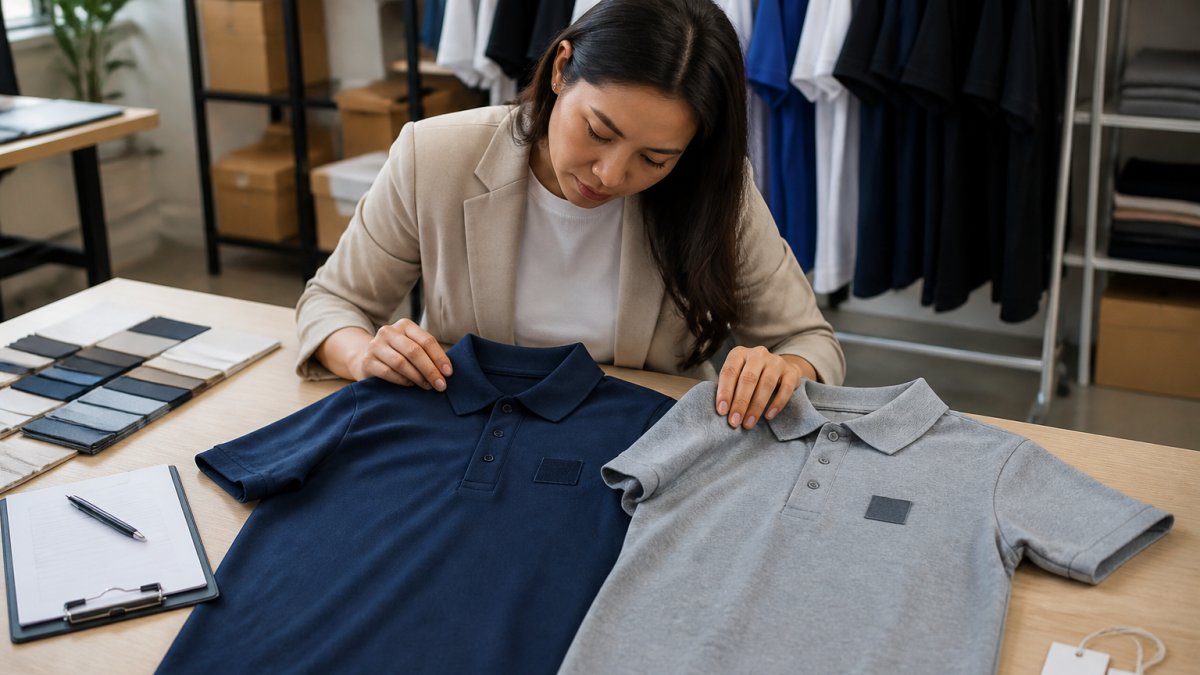
Most buyers treat the sample as a formality. It is the only point where you can reject a garment before paying for hundreds, so treat it as a structured approval.
Order the Right Kind of Sample
Three sample types answer different questions:
- Blank sample, an undecorated garment in your target style, color, and size. Confirms fabric hand-feel, weight, fit, and dye lot before any decoration is committed.
- Pre-production (PP) sample, your actual artwork decorated on the actual garment. Confirms logo placement, color match, stitch or print quality, and sizing on the finished piece.
- Size set, one garment in each size you plan to order. Confirms grading (how the pattern scales from small to 3XL) rather than assuming the fit holds across the range.
If your order is large or your deadline fixed, request all three. If you can only get one, get the PP sample, the only one showing the finished product.
A Sample Evaluation Protocol
Work through the sample in this order; each step filters out a class of defect.
- Paperwork check. Confirm the fiber content and care label match the spec sheet you approved. The FTC's guidance on textile labeling requires accurate fiber content and care disclosure on garments sold in the U.S., so a mismatch here is a legal problem, not a cosmetic one.
- Construction check. Run your thumb along the shoulder, side, and armhole seams. Look for double-needle stitching, taped neck and shoulder seams, and cleanly finished hems. Single-stitched seams on a garment sold as uniform-grade are a red flag.
- Decoration check. Measure logo placement against your approved spec, not by eye. Confirm the logo is centered, level, and the correct size. For embroidery, check stitch density and look for puckering or dropped stitches. For screen print or DTF, check ink coverage, edge sharpness, and whether the print sits flat without cracking when you stretch the fabric gently.
- Color check. Compare the garment and the decoration against your brand guide under daylight, not under office fluorescents. Fluorescent light shifts blues and greens and will hide a bad match.
- Fit check. Have at least two people of different body types try the sample. A garment that fits one person well can be cut wrong for the rest of your team.
The Wash Test: Your Best Durability Signal
A sample that looks perfect on delivery can fail after two washes if the ink was under-cured or the fabric not pre-shrunk. The wash test is the cheapest durability test you will run.
Wash the sample three times following the care label exactly. Then check:
Customized DTF Shirt with your own logo →
- Shrinkage, measure the body length and chest width before and after. More than about 5% shrinkage on a cotton tee is a problem for sizing consistency across a bulk order.
- Colorfastness, look for fading, bleeding onto other garments, or dye transfer at the seams.
- Print integrity, check for cracking, peeling, or flaking, especially at stress points like the shoulders and chest.
Watch Out
Skipping the wash test is the most common and most expensive mistake in promotional apparel. A print that looks perfect on delivery can crack after two washes if the ink was under-cured, and by then the full run is already printed.
Sample Evaluation Checklist
Use this checklist when evaluating any sample:
- Fiber content and care label match the spec sheet
- Stitch density is tight and even along all seams
- Logo placement is centered and level (measured, not eyeballed)
Care Instructions After the Order Lands
Once the bulk order lands, the care instructions you give recipients determine how long the branding survives. Print them on a card, add them to the packing slip, or post them where garments are distributed:
- Wash inside out in cold water to protect the decoration.
- Tumble dry low, or hang dry if the garment is a performance fabric.
- Avoid fabric softener, which leaves a residue that can dull prints and break down embroidery backing.
Proper care extends garment longevity and keeps branding crisp, the whole point of paying for quality.
Plan for Lead Times, Sustainability, and Post-Production Care
Three things separate a smooth order from a stressful one: whether the garment is in stock, whether the vendor can document where it came from, and whether you built enough buffer into the calendar.
Lead Time: Build the Timeline Backward
Standard decorated apparel runs typically take two to four weeks from artwork approval, but that assumes the blank is in stock and the artwork approved on the first pass. Both assumptions fail often.
Work backward from your in-hands date:
- In-hands date, when the garments must physically be in your hands, not when the event starts.
- Shipping buffer, add three to five business days for ground shipping, more for peak season (October through December) when carrier networks slow down.
- Production window, two to four weeks for standard decoration, longer for embroidery-heavy orders or large runs.
- Artwork approval, add three to five business days for the first proof, plus a revision cycle if changes are needed.
- Sample approval, add one to two weeks if you are ordering a PP sample before the bulk run.
If the math does not work, you have three levers: simplify the decoration, switch to a blank that is confirmed in stock, or pay for a rush.
Stock Reliability: Ask Before You Commit
A vendor can quote a garment that is not actually available in your size and color. Ask these questions before approving the order:
- Is the blank confirmed in stock in every size and color in my order, or is some of it on backorder?
- If a size or color runs out mid-production, what is the substitution policy, and who approves the substitute?
- Can you ship a partial order to hit my date, or does the whole run ship together?
A vendor who cannot answer these clearly is a vendor who will surprise you later.
Sustainability and Ethical Sourcing: Ask Direct Questions
Sustainability claims are easy to make and hard to verify. Cut through by asking specific, answerable questions and seeing which vendors have real answers.
- Fiber sourcing, Is the cotton organic, recycled, or conventional? Can the vendor provide documentation?
- Certifications, Does the garment carry a recognized certification for organic content, recycled content, or responsible textile production? Ask for the certificate, not just the logo.
- Decoration location, Where is the garment decorated? Domestic decoration is easier to audit than overseas decoration, and it shortens the supply chain.
You do not have to buy the most sustainable option. You do have to know what you are buying, because corporate buyers, government agencies, and event sponsors increasingly ask.
Post-Production Care Protects the Investment
Once the order lands, the care instructions you distribute determine how long the branding survives. Give recipients clear guidance:
- Wash inside out in cold water.
- Tumble dry low, or hang dry for performance fabrics.
- Skip fabric softener, which leaves residue that dulls prints and degrades embroidery backing.
A one-page care card costs almost nothing and prevents the most common cause of premature print failure: heat damage from a hot dryer or iron.
The three decisions that matter most are fabric weight, decoration method, and sample verification. Get those right, then protect the order with a realistic lead-time buffer, a stock confirmation, and clear care instructions.
Conclusion: A Practical Checklist for Choosing Quality Custom Apparel
Choosing quality custom apparel comes down to matching the garment to its job, verifying construction and decoration on a real sample, and planning enough lead time.
At 2mepromo.com, we handle the full spec for government agencies and small businesses, from Customized DTF Shirt with your own logo to DTF Gildan 2000 Soft Style Shirts built for high-visibility roles.


Get started with 2mepromo.com and order apparel your team will actually wear.
Frequently Asked Questions
What fabric weights are best for custom business apparel?
For custom apparel worn in professional settings, midweight fabrics work best. Look for 5.5 to 6.5 oz (roughly 185 to 220 GSM) for t-shirts, which balance durability with comfort. Polos typically run heavier. Lighter weights under 5 oz feel thin and tend to show wear faster, while anything above 7 oz can feel stiff for office or event use. Always check the GSM and fabric weight on the spec sheet before ordering.
How do I know if a custom apparel vendor's printing will hold up?
Ask for a pre-production sample and wash it at least five times before committing to a bulk order. Check for cracking, fading, or peeling at the print edges. Screen printing on ring-spun cotton holds color well when cured properly, and embroidery generally outlasts printed decoration on garments that get frequent washing. A vendor confident in their process will not hesitate to send a sample.
How do you choose the right printing method for custom apparel?
Match the method to the garment and the logo. Screen printing suits large, bold designs on flat surfaces and keeps costs down at higher quantities. Direct-to-garment (DTF) handles detailed, multicolor artwork and small runs without setup fees. Embroidery works best on polos, jackets, and caps where a raised, stitched logo reads as more professional. Consider the fabric, the design complexity, and how often the garment will be washed.
Why does garment durability matter for brand identity?
Faded, cracked, or shrinking apparel reflects poorly on your organization every time someone wears it. Employees and event attendees notice when a logo peels after a few washes, and that undermines the professional image you paid to build. Choosing higher stitch density, quality fabric, and tested decoration methods keeps your brand looking sharp for years rather than months.
- Choosing a selection results in a full page refresh.
