Your cart is empty
Looks like you haven't added anything to your cart yet







Portable Trade Show Booth Ideas for Small Businesses 2026
Table of Contents
- Portable Trade Show Booth Ideas for Small Businesses 2026: What Actually Fits a 10x10 Space
- 10x10 Trade Show Booth Layout Ideas That Make a Small Footprint Feel Bigger
- Portable Display Systems Built for Setup in Under 10 Minutes
- Custom Promotional Signage for Events: Tents, Table Throws, and Retractable Banners
- Trade Show Engagement Strategies That Turn Foot Traffic Into Conversations
- Best Trade Show Swag Ideas 2026: What Small Businesses Should Hand Out
- Shipping, Drayage, and Storage: The Costs Competitors Skip
- Conclusion: Build a Booth You Can Actually Carry, Set Up, and Reuse
- Frequently Asked Questions
Last Updated: September 28, 2026
Portable Trade Show Booth Ideas for Small Businesses 2026: What Actually Fits a 10x10 Space
A 10x10 booth is the smallest standard footprint on most show floors, and it is the one most small businesses book. That constraint is not a limitation so much as a design brief. This guide from 2mepromo.com covers the portable trade show booth setups that actually work in that space: layouts, hardware, signage, and the logistics nobody warns you about.
10x10 Trade Show Booth Layout Ideas That Make a Small Footprint Feel Bigger
The best 10x10 layout is the one that lets a stranger understand your business in three seconds from the aisle. Everything else is secondary.
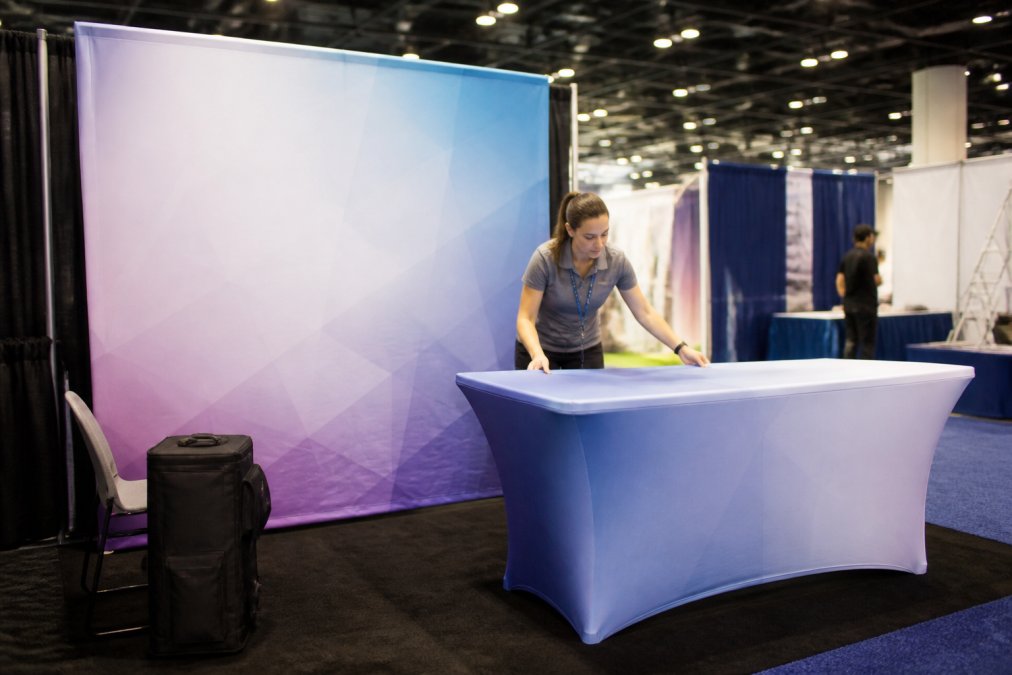
Three layouts cover almost every small-booth scenario:
- Backwall anchor: One large graphic across the rear, open floor in front
- L-shape: Backwall plus one side wall, creating a semi-enclosed corner
- Open-front U-shape: Walls on three sides with a wide entry, best for demo-heavy products
The Backwall Anchor: Why One Strong Graphic Beats Five
One large graphic beats five small ones because the eye resolves a single image faster than a cluster. A backwall that spans the full 10 feet gives you edge-to-edge brand visibility without visual noise.
L-Shape, U-Shape, and Open-Front: Which Layout Fits Your Goal
Match the layout to what you need the booth to do.
| Layout | Best For | Trade-Off |
|---|---|---|
| Backwall anchor | Brand awareness, high traffic aisles | Less enclosed, no storage |
| L-shape | Lead capture, consultation seating | Blocks one approach angle |
| Open-front U-shape | Product demos, hands-on trials | Needs more hardware |
Portable Display Systems Built for Setup in Under 10 Minutes
A portable display system is trade show hardware designed to assemble without tools, fit in a carry case, and ship as standard luggage. Setup time is the spec that matters most for a small team.
Pro Tip
Time your first assembly at home, not on the show floor. Convention hall carpet, cramped aisles, and a 7 a.m. move-in window add minutes you did not budget for.
Fabric Tube Displays: EZ Stand vs. EZ Tube Straight vs. the Prime Tension Model
All three use the same pillowcase mechanic: slide the tubes, snap them, pull the graphic over, zip it shut.
- 10ft. EZ Stands Fabric Tube Display: thinner tube diameter, curved corners, 9 lb shipping weight, fits a compact silver bag
- 10 ft EZ Tube Straight Display: 44 lb package, includes a wheeled medium hard case
- Prime 10ft. Tension Fabric Tube Display: 48 lb package, ships in a travel bag
Modular vs. Pop-Up: When to Pick EZ Tube Connect or Tahoe Twistlock X
Choose modular when your booth needs to change shape between shows. Choose pop-up when it never will.


![[Prime] 10ft. Tension Fabric Tube Display](https://cdn.shopify.com/s/files/1/0712/7492/2209/files/ONE-CHOICE-10-Ft.-Fabric-Display-Straight-Single-Sided-Graphic-Package-White-Back_1.jpg?v=1785101879)
Custom Promotional Signage for Events: Tents, Table Throws, and Retractable Banners
Custom promotional signage for events does three jobs: it identifies your space, it carries your message above the crowd, and it works as a photo backdrop. Skipping any one of them costs you visibility.
- Full Color Custom Table Throw: dye-sublimated, sized for 4-foot, 6-foot, and 8-foot tables
- 60" SilverStep Retractable Banner Stand: lifetime hardware warranty, adjustable pole, graphic heights from 85 to 92 inches
- Custom Tent Canopy Tent: 10x10 frame, full fabric dye-sub canopy printed seam to seam
Watch Out
The Pop Up Podium case is rated for storage only, not shipping. If you plan to freight your counter, pack it inside a separate shipping crate or you will be replacing it after the first show.
Trade Show Engagement Strategies That Turn Foot Traffic Into Conversations
Trade show engagement strategies work when they give a passerby a reason to stop that is not "Can I tell you about our product?" The booth needs a hook, and the hook needs to be visible from the aisle.
Three approaches that consistently pull people in:
- A live demo station where visitors touch the product
- A single qualifying question printed large on the backwall
- A scheduled in-booth talk at a fixed time, announced on a small sign
The 30-Second Capture Rule
Pair the hook with a lead capture method that takes under 30 seconds. Badge scanners work. So does a simple form on a tablet. Long forms kill booth conversations.
A workable loop looks like this:
10ft. EZ Stands Fabric Tube Display →
- Tag at capture. Every scan gets one of three tags: hot (ready to talk now), warm (interested, wrong timing), or info-only. This takes two seconds and saves hours later.
- Sync same day. Most badge scanners export a CSV or push directly into a CRM. If yours only exports, set a calendar reminder to upload before you leave the hall each night.
- Send a personalized follow-up within 24 hours. Reference something specific from the conversation. "You mentioned you were evaluating vendors before your Q3 renewal" beats a generic "Great meeting you."
- Route by tag. Hot leads go to a rep the next business day. Warm leads go into a nurture sequence. Info-only goes into a newsletter list.
Pro Tip
Test your capture-to-CRM handoff before the show, not after. Scan your own badge, run it through the export, and confirm it lands in the right pipeline stage. A broken integration discovered on the show floor is a broken integration for the whole event.
Staffing the Booth for Conversation, Not Coverage
A 10x10 booth does not need four people. It needs two who can hold a conversation and one who can float. More staff than that and people start talking to each other instead of to attendees.
Key Takeaway
The booth is not the asset. The follow-up is. A modest 10x10 with a disciplined capture-to-CRM loop outperforms a larger booth with a stack of business cards and good intentions.
Best Trade Show Swag Ideas 2026: What Small Businesses Should Hand Out
- Insulated drinkware that sits on a desk
- Branded apparel worn at the gym or on weekends
- Practical tools like cable organizers or phone stands
- Notebooks with a cover people actually like
Key Takeaway
The test is not "would someone take this?" It is "would someone use this where a colleague can see it?" That second question is what separates swag from advertising.
Order swag and apparel in the same production run as your signage where possible. Matching colors across a tent, a table throw, and a staff shirt reads as one brand instead of three.
Shipping, Drayage, and Storage: The Costs Competitors Skip
Drayage is the fee a show contractor charges to move your materials from the loading dock to your booth floor, and it is the line item that surprises first-time exhibitors most. It applies even when you carry the case in yourself.
Three costs that rarely appear in booth planning:
- Round-trip freight on a hard case, which is billed by dimensional weight
- Drayage, charged per hundredweight with a minimum
- Advance warehouse fees if your shipment arrives before move-in day
Pro Tip
Ask the show organizer for the drayage rate sheet before you book the booth, not after. The material handling rate and the minimum charge are published in the exhibitor service manual.
How to Estimate Your All-In Logistics Cost Before You Commit
You will not get an exact number until the exhibitor service manual is published, usually six to eight weeks before the show. But you can build a working estimate with four inputs:
- Total shipment weight, including the case, the display, the counter, and any product samples
- Dimensional weight, which is length times width times height divided by the carrier's divisor, for most ground services the divisor is 139
- The show's material handling rate, quoted per hundredweight with a minimum charge
- Advance warehouse surcharge, if your freight arrives before the official move-in window
Buy vs. Rent: A Decision Matrix for Small Exhibitors
The buy-versus-rent question is the one most guides skip, and it is the one that decides whether a small business can afford to exhibit at all. The answer depends almost entirely on how many shows you plan to attend.
| Scenario | Recommended Path | Why |
|---|---|---|
| One show, testing the waters | Rent or borrow | Avoids capital outlay and storage |
| Two to three shows per year | Buy a portable fabric system | Pays for itself quickly; reusable graphics |
| Four or more shows per year | Buy modular | Reconfigures across booth sizes and layouts |
| Shows in different cities, flying | Buy lightweight fabric | Avoids drayage and freight on every trip |
| Shows within driving distance | Buy modular with hard case | Case survives transport; no airline weight limits |
Watch Out
Rental graphics are typically show-specific and cannot be reused. If you rent the same booth three times, you have often paid for a purchase without owning anything. Run the math before you sign a rental agreement for a recurring show.
Conclusion: Build a Booth You Can Actually Carry, Set Up, and Reuse
The booth that wins is the one your team can carry, assemble in five minutes, and pack without a forklift. Weight and setup time are the specs that decide whether you exhibit again next year.
Frequently Asked Questions
What are the trends in trade show booth design for 2026?
Small businesses are moving toward lightweight fabric displays that ship in a single case and set up without tools. Tension fabric backwalls, retractable banner stands, and modular tube frames dominate because they cut setup time to about five minutes. Dye-sublimation printing keeps colors sharp through repeated shows, and modular systems like the EZ Tube Connect let you rearrange the same hardware into new shapes for different events. The bigger shift is planning the booth around post-show follow-up, not just the visual.
What are some good trade show swag ideas for 2026?
Skip the pens nobody keeps. Useful items tied to your service get carried home: branded drinkware, notebooks, tote bags, and phone accessories. For government agencies and small businesses, custom apparel and branded staff shirts double as swag when a visitor asks about your team. Pair one premium giveaway with a lower-cost item so you have something for every visitor tier. Match the swag to your booth theme so it reinforces the message instead of competing with it.
How can small businesses maximize a 10x10 trade show booth layout?
Treat the backwall as your single strongest graphic and resist filling every centimeter. Keep the front two feet open so attendees can step in without feeling blocked. Add one vertical element, like a retractable banner or a counter, to pull the eye upward. A podium gives you storage and a conversation anchor without eating floor space. If you need more surface area, a modular system like the Tahoe Twistlock X adds shelving and a table inside the same footprint.
What are the most effective portable display solutions for 2026?
Fabric tube displays remain the workhorse for small businesses because they weigh under 50 pounds, ship in a wheeled case, and assemble in about five minutes. The 10 ft. EZ Tube Straight Display and the Prime 10ft. Tension Fabric Tube Display both fit this mold. For exhibitors who want to reconfigure the same hardware across multiple shows, the EZ Tube Connect kits offer straight, round, and slanted top options. Backlit fabric and SEG light boxes add visual impact at a higher price point.
What makes a trade show booth stand out to attendees?
Contrast and clarity beat decoration. A single bold backwall graphic with one clear message reads from across the aisle, while busy collages disappear. Add one interactive station, like a demo screen or a spin-to-win wheel, to give people a reason to stop. Light helps: backlit fabric backdrops and SEG light boxes pull the eye in dim halls. Finally, staff who stand in front of the table instead of behind it start more conversations than any display can.
- Choosing a selection results in a full page refresh.
