Your cart is empty
Looks like you haven't added anything to your cart yet








Promotional Signage Alternatives to Digitized Logos
Table of Contents
- Why Switch From Your Current Promotional Signage Vendor
- Custom Signage Branding Best Practices for Small Business
- Fabric Display Systems vs. Standard Backwall Alternatives
- GSA Compliance for Small Business Vendors in Promotional Procurement
- Corporate Event Signage Solutions That Deliver Results
- Quality Durability and Long-Term Value
- Frequently Asked Questions
Last Updated: September 20, 2026
Why Switch From Your Current Promotional Signage Vendor
Many businesses stick with their existing vendor out of habit, but promotional signage alternatives offer real cost savings when misalignment exists between what you need and what your current vendor delivers. The decision to switch should be driven by specific pain points:
Turnaround time misalignment. If your current vendor requires 3-4 weeks lead time but your events are planned with 2 weeks' notice, you're forced to rush-order at premium rates or miss opportunities. A vendor offering 2-business-day turnaround removes this constraint.
Design support gaps. Many vendors provide templates but minimal design collaboration. If you're spending hours revising mockups or working around limited customization, you're absorbing costs your vendor should handle. Better vendors include design consultation, catching brand inconsistencies before production.
Material durability mismatches. Dye-sublimation printing on stretch fabric resists fading and cracking, extending system life significantly.
Compliance and procurement friction. If you sell to government agencies, your vendor's GSA registration status and compliance reporting matter. A vendor that handles this seamlessly saves your team hours of back-and-forth.
Scalability constraints. Your current vendor may excel at large orders but struggle with rush timelines. If your business is growing and your vendor can't scale with you, you'll outgrow them. A vendor handling both small custom orders and large-volume production gives you flexibility.
Pro Tip
Before switching vendors, audit what your current provider does well and where they disappoint. Your next vendor should excel in your weak spots. Calculate the cost of staying (missed events, labor hours, replacement cycles) against the cost of switching. If the math favors switching, move.
Your current vendor might excel at one thing while falling short on others. Exploring promotional signage alternatives that match your actual workflow beats staying with a generalist that makes you compromise on multiple fronts.
2mepromo.com specializes in exactly this: tailored solutions for government agencies and small businesses that need custom branding without the generic catalog experience. The difference becomes obvious when you compare turnaround times, material durability, and the level of design collaboration you actually receive.
Custom Signage Branding Best Practices for Small Business
Small businesses often approach custom signage as an afterthought. Your signage is one of the few marketing tools that works 24/7, whether someone's at your booth, walking past your office, or seeing photos on social media.
Custom signage branding starts with consistency. Your logo, color palette, and typography should match your website, email templates, and printed materials.
The second principle is visibility. Your signage should use high-contrast colors, readable fonts at distance, and strategic placement. Test designs from 10 feet away; if you can't read the key message, redesign it.
Third is durability. Invest in dye-sublimation printing on stretch fabric. The upfront cost is higher, but it lasts years instead of months.
Key Takeaway
The brands that stand out at events aren't the ones with the biggest budgets, they're the ones whose signage is crisp, readable, and consistent across every touchpoint.
Fabric Display Systems vs. Standard Backwall Alternatives
Fabric display systems have largely replaced rigid backwall alternatives: they're lighter, pack smaller, assemble faster, and look more professional. The decision extends beyond appearance to installation logistics, maintenance, and total cost of ownership.
Tension fabric systems use aluminum frames with stretch fabric graphics. They assemble in minutes without tools, creating a seamless, wrinkle-free display. These systems ship in compact bags and weigh a fraction of traditional backwalls.
Maintenance is minimal: wipe down the frame, store the fabric flat or loosely rolled, and the system remains event-ready for years.
Standard rigid backwalls, plywood, foam core, or plastic panels, offer more flexibility and cheaper upfront cost. But they're heavy (150+ pounds), take longer to set up (30-45 minutes), scratch easily, and look dated next to modern fabric systems.
Installation and on-site setup heavily favor fabric systems. Fabric displays reduce setup time by 80-90% compared to rigid alternatives, translating directly to labor cost reduction.
Storage and transportation logistics tilt toward fabric. Fabric systems' compact footprint and light weight reduce storage rental costs and eliminate freight services. Rigid systems often require climate-controlled storage, adding ongoing expense.
Durability and replacement cycles matter for long-term ROI. Fabric systems with dye-sublimation printing typically remain event-ready for 5-7 years with minimal maintenance. Rigid systems, especially plywood, degrade faster and require replacement or significant refurbishment every 2-3 years. When you calculate cost per event, fabric systems often cost 40-60% less over a 5-year period despite higher upfront cost.
For most small businesses and government agencies, fabric systems look professional, travel easily, require minimal setup, and demand almost no maintenance.
8x10 flat banner stand / step n repeat →
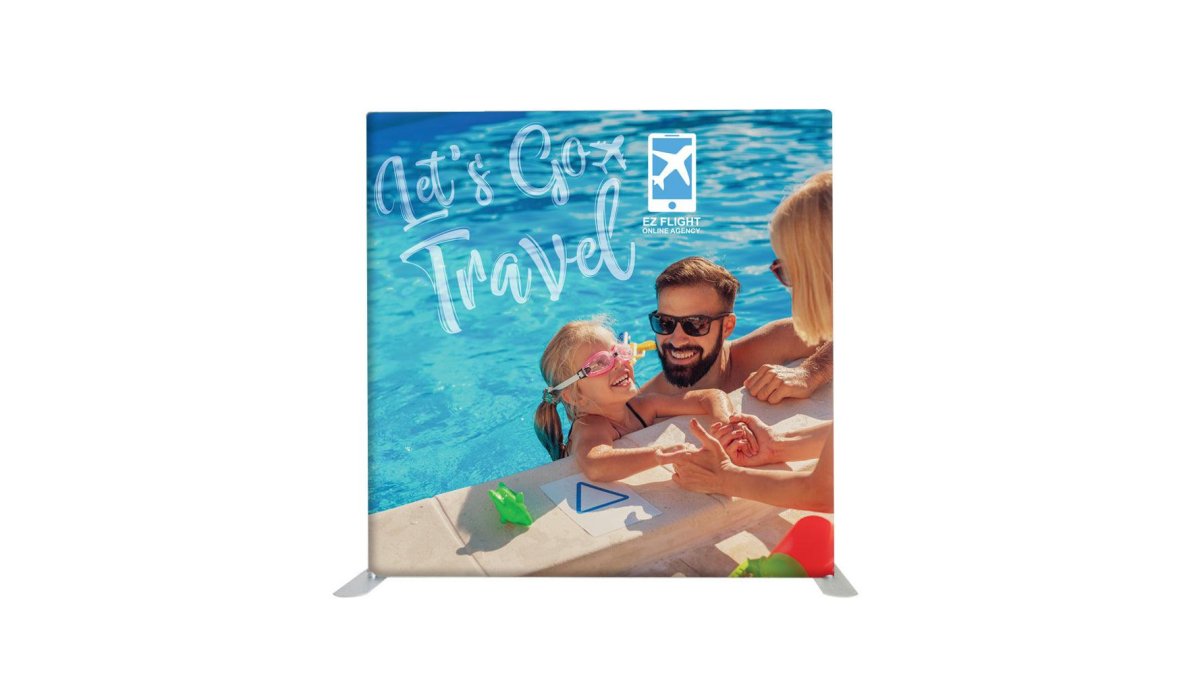
8x10 Flat Banner Stand for Large-Scale Events
The 8x10 flat banner stand is built for impact at large events. At 112 inches wide by 91.5 inches tall, it dominates a booth or stage backdrop. The frame assembles in 5 minutes with no tools, slide the aluminum tubes together, lock them with push-button snaps, and pull the stretch fabric graphic over like a pillowcase.

The dye-sublimation printing on the fabric produces vibrant colors that hold up under event lighting. The hidden zipper keeps the fabric taut, eliminating wrinkles that make cheaper displays look sloppy. The whole system, frame and graphic together, fits in a compact silver bag that weighs 48 pounds, heavy enough to feel solid, light enough that one person can move it.
This display works for trade shows, conferences, outdoor events, and corporate activations. It's the kind of setup that makes your booth the one people remember.
Adjustable Slider Banners for Flexible Branding
Not every event needs a massive 10-foot display. The Indoor Slider Banner Stands adjust from 8 feet to 10 feet wide, letting you scale your backdrop to fit your space.
![[Prime] Indoor Slider Banner Stands](https://cdn.shopify.com/s/files/1/0712/7492/2209/files/ONE-CHOICE-Slider-Banner-Stands_Graphic_20Package-10x7.5_20ft-01.jpg?v=1785099567)
The aluminum frame uses a slider mechanism, the poles telescope, so you can display larger graphics on smaller frames. Graphics are printed on dye-sublimation stretch fabric with pole pockets top and bottom for easy installation. Setup takes minutes. The whole package ships in 2 business days after proof approval.
This system works for smaller conference booths, indoor retail displays, and corporate events where space is tight. You get professional appearance without the footprint of a full 10-foot system.
Compact Display Solutions for Smaller Spaces
The Mini Slider Indoor Banner Stand adjusts from 37.5 inches to 70.5 inches wide and 37 inches to 96 inches tall. It's ideal for small retail spaces, office lobbies, and intimate events where a full-size backdrop would overwhelm the room.

The telescopic poles let you use larger graphics on smaller frames, which means you're not limited to tiny designs. The stretch fabric is dye-sublimated for durability. It comes with a black nylon carry bag, so transport and storage are simple.
This is the right choice when your space is limited but your brand visibility standards aren't.
GSA Compliance for Small Business Vendors in Promotional Procurement
Government agencies operate under specific procurement rules. If you're bidding for government contracts or selling to government departments, understanding GSA compliance matters.
The General Services Administration (GSA) maintains approved vendor lists for businesses selling to federal agencies. Being GSA-registered doesn't mean you're automatically qualified for every contract, but it opens doors. It signals to government buyers that you've met basic standards for reliability, financial stability, and product quality. 2mepromo.com works with government agencies and understands the compliance landscape.
Small businesses often assume GSA compliance is complex and expensive. It's not. The process involves registering your business, providing documentation of your capabilities, and maintaining compliance through accurate reporting. Many small vendors skip this step and miss out on government procurement opportunities.
2mepromo.com works with government agencies and understands the compliance landscape. If you're selling promotional items or custom signage to government departments, ask your vendor whether they're GSA-registered and what that means for your orders. 2mepromo.com works with government agencies and understands the compliance landscape.
Corporate Event Signage Solutions That Deliver Results
Corporate events, conferences, product launches, awards ceremonies, team retreats, demand signage that reflects your brand's professionalism. This isn't the place to cut corners on printing quality or design support.
Effective corporate signage starts with clear hierarchy. Your main message should dominate. Secondary information should support it without competing. Your logo should be visible but not overwhelming.
Quality Durability and Long-Term Value
Durability comes from material choices. Dye-sublimation printing bonds color into the fabric rather than sitting on top of it. This resists fading, peeling, and cracking. Stretch fabric is more forgiving than vinyl, it won't crack if the frame flexes slightly during transport.
Key Takeaway
A signage system that costs 30% more but lasts 3 times longer is actually the cheaper option. Calculate cost per use, not just sticker price.
Frequently Asked Questions
What should you look for when choosing a promotional signage vendor?
Prioritize vendors who offer quality assurance on materials, provide fast turnaround times (ideally 2 business days or faster), and have experience with your industry's compliance requirements. Look for companies that handle design mockup approval, provide durable substrates like stretch fabric with dye-sublimation printing, and offer multiple display size options. Verify they can manage your full project scope, whether you need custom signage or event materials, rather than specialists in just one product category.
How do promotional signage alternatives compare in terms of durability and cost?
Fabric-based display systems offer superior durability compared to standard vinyl backdrops, with dye-sublimation printing that resists fading. Tension fabric systems with aluminum frames provide lifetime hardware warranties and one-year graphic warranties, protecting your investment. While initial costs range from $168.51 for adjustable slider banners to $499 for large format displays, the longevity and reusability of these systems deliver better long-term value than cheaper single-use alternatives that degrade after a few events.
How does GSA compliance impact promotional product procurement for government agencies?
GSA compliance ensures your vendor meets federal procurement standards required for government contracts, which many small businesses and county departments must follow. Choosing a GSA-compliant promotional signage vendor streamlines your purchasing process, reduces compliance risk, and ensures your branded materials meet quality and documentation requirements. This is especially important for government agencies ordering signage and event materials that must meet federal specifications and procurement protocols.
What types of signage are most effective for corporate events and trade shows?
Large format fabric displays with high visual impact work best for corporate events. Options like 8x10 step-and-repeat banners and adjustable slider systems (ranging from 8'x7.5' to 10'x8') provide professional backdrops for brand visibility and photography. These systems assemble in minutes without tools, pack into compact bags for transport, and display vibrant dye-sublimated graphics. Choose adjustable displays if you need flexibility across different event sizes, or fixed-size systems for consistent branded installations.
- Choosing a selection results in a full page refresh.
