Your cart is empty
Looks like you haven't added anything to your cart yet







Custom Apparel for Government Agency Staff: 2026 Guide
Table of Contents
- Types of Custom Apparel for Government Agency Staff
- Durable Custom Workwear for Public Sector: What to Look For
- Custom Logo Embroidery Services and Decoration Methods
- Government Agency Uniform Policy: Compliance and GSA/TAA Considerations
- Bulk Ordering, Pricing, and Procurement for Custom Apparel
- Lifecycle Management, Budgeting, and Inclusive Sizing
- How to Order Custom Apparel for Government Agency Staff
- Conclusion
Last Updated: August 24, 2026
Government agencies face a procurement challenge that private businesses rarely deal with: uniforms must survive field operations, pass compliance reviews, represent the agency professionally, and hold up through industrial laundry cycles, all at justifiable public cost. At 2mepromo.com, we work directly with procurement officers, department heads, and HR administrators who need custom apparel for government agency staff that checks every box. This guide covers what to order, what to look for in materials and decoration, and how to navigate GSA compliance and bulk procurement.
Quick Reference:
- Best for field and security staff: Tactical snag-resistant polo with mic clips
- Best for office environments: Dimension Knit dress shirt, moisture-wicking with structured fit
- Best for outdoor operations: Soft shell jacket or vest with water-repellent shell
- Best budget-conscious vest: Core Soft Shell Vest starting at $49.99
Types of Custom Apparel for Government Agency Staff
Custom apparel for government agency staff falls into three functional categories: tactical field wear, professional office apparel, and protective outerwear. Ordering the wrong type for a department is a common and costly mistake.

Tactical Polos for Field and Security Staff
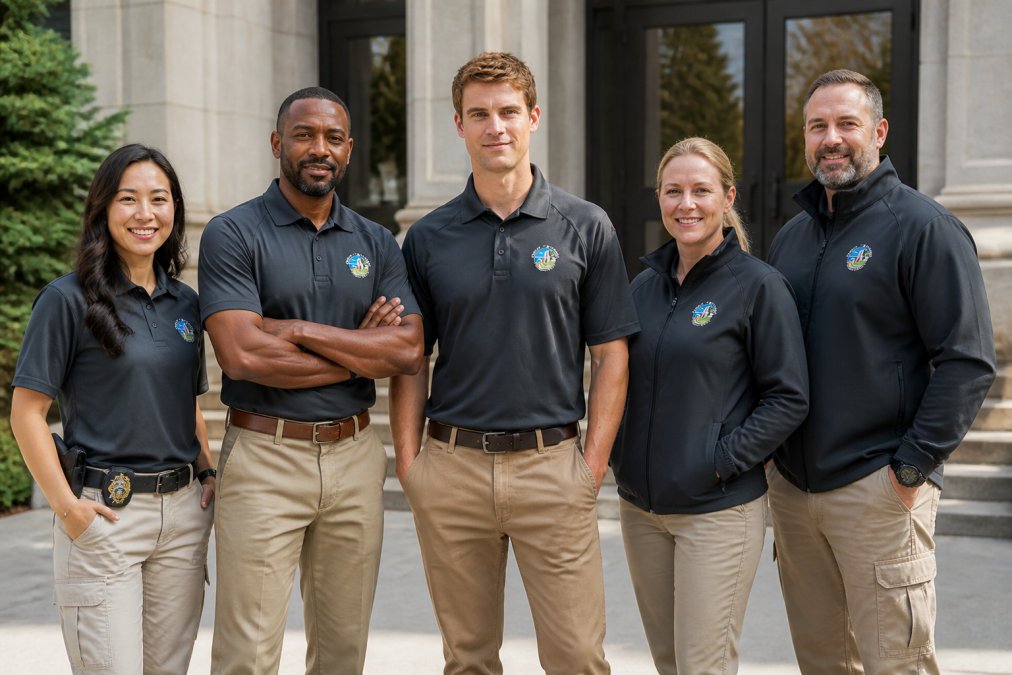
Standard cotton polos fall apart within months under daily field use. The Snag Resistant Polo Corner Stone DCSS ($29.95) is built for event staff, security, and law enforcement. The 6.6-ounce snag-proof polyester construction resists tears from equipment and fencing contact. Strategically placed mic clips at the center placket and shoulders keep communications gear secure. Dual reinforced pen pockets on the left sleeve handle constant documentation cycles, and moisture-wicking fabric manages body temperature during outdoor assignments. The Corner Stone Ladies Polo ($29.99) mirrors these specs with a traditional fit designed for women. Both versions feature tag-free labels for comfort during extended wear.

Pro Tip
Order mic clip polos for any role using two-way radios or body cameras. The clip placement prevents improvised solutions that damage fabric and look unprofessional on camera.
Dress Shirts and Office-Ready Apparel
The K570 Port Authority Dimension Knit Dress Shirt ($35.98) solves the stiff-versus-comfortable trade-off. The 3.8-ounce micropique polyester tricot construction gives visual structure with the stretch and moisture-wicking performance of a knit. The versatile collar works open or buttoned down, and rounded adjustable cuffs accommodate varying sleeve lengths. This shirt carries the Agency Contract Support designation, making it practical for administrative and community services departments. The L570 ladies version ($39.99) comes with custom embroidery applied, making it ready-to-deploy for departments needing branded apparel without managing a separate decoration step.
Outerwear: Jackets and Vests for Outdoor Operations
The J317 Soft Shell Jacket ($49.99) carries a 1000MM fabric waterproof rating and 1000G/M² breathability rating. The 100% polyester woven shell bonds to a water-resistant film insert and microfleece lining, blocking wind while managing moisture from inside out. Reverse coil zippers and a zip-through cadet collar with chin guard add practical weather protection. For staff needing core warmth without restricting arm movement, the CECO J325 Port Authority Core Soft Shell Vest ($55.00) and CECO L325 ladies version ($49.99) deliver the same waterproof shell and microfleece lining in vest configuration.

Durable Custom Workwear for Public Sector: What to Look For
Durable custom workwear for the public sector requires fabric specs that survive industrial laundry, not just regular consumer washing. Municipal uniform programs wash garments at commercial facilities using high-temperature cycles, industrial detergents, and mechanical extraction. Three fabric properties matter most: snag resistance (polyester constructions rated snag-proof hold up against equipment and fencing contact), moisture-wicking performance (field staff need fabrics that move sweat away from skin; cotton retains moisture and creates discomfort), and colorfastness (dyed-to-match construction maintains color consistency across multiple wash cycles).
The per-unit cost matters less than the cost-per-wear. A $30 polo lasting 18 months of weekly industrial laundry is a better procurement decision than a $20 shirt degrading in six months. Factor laundry durability into specifications before finalizing any bulk order.
Watch Out
Avoid cotton-heavy blends for field staff uniforms. Cotton absorbs and retains moisture, promotes odor, and degrades faster under industrial laundry conditions. Stick to polyester or polyester-blend constructions rated for professional laundering.
According to the General Services Administration's guidance on federal procurement standards, agencies purchasing apparel under government contracts should verify that textiles meet applicable performance standards before committing to bulk orders.
Custom Logo Embroidery Services and Decoration Methods
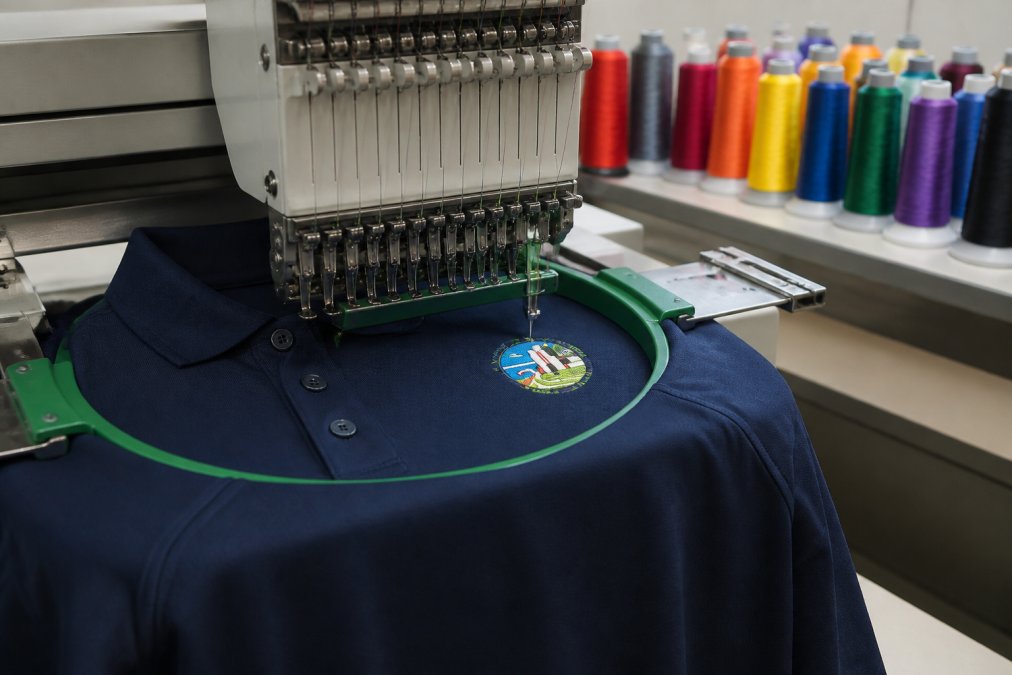
Custom logo embroidery is the standard decoration method for government agency uniforms because embroidered logos withstand industrial laundry, maintain professional appearance, and carry permanence that screen printing cannot match on workwear.
| Method | Best Application | Durability | Detail Level |
|---|---|---|---|
| Embroidery | Polos, jackets, vests, dress shirts | Highest, survives industrial laundry | Medium, works for seals and text |
| Screen printing | T-shirts, event giveaways, civic event apparel | Good for standard wash | High, sharp edges, full color |
| Heat seal / heat transfer | Lightweight event items, temporary use | Lowest | High, photographic quality possible |
For standard government agency uniform programs, embroidery is the correct choice. Screen printing works well for civic event giveaways and items that won't go through commercial laundering. Heat seal applications suit short-term event apparel where cost per unit matters more than longevity.
A common mistake is submitting low-resolution artwork for embroidery digitization. Embroidery requires a digitized file where every stitch path is mapped. Clean vector files in AI or EPS format produce the sharpest results and avoid revision delays.
Pro Tip
Government seals with fine detail, thin lines, and small text often require simplification for embroidery. Work with your decorator to create an embroidery-optimized version of your seal that reads clearly at left-chest size (typically 3-4 inches).
Government Agency Uniform Policy: Compliance and GSA/TAA Considerations
Government agency uniform policy intersects with federal procurement law, trade compliance requirements, and agency-specific standards that private sector buyers never encounter.
The most important compliance framework for federal and many state agency purchases is the Trade Agreements Act. As documented in the TAA compliance overview from the U.S. General Services Administration, the TAA requires that products purchased under GSA Schedule contracts be manufactured or substantially transformed in designated countries. For apparel procurement, this means verifying country of origin before committing to a bulk order under a GSA contract vehicle.
Key compliance considerations for government apparel procurement:
- TAA compliance: Verify that textiles are manufactured or substantially transformed in TAA-designated countries when purchasing under GSA Schedule contracts
- ANSI/ISEA standards: For hi-vis vests and safety apparel used in roadway or construction-adjacent operations, garments must meet ANSI/ISEA 107 standards
- Agency uniform policies: Many agencies maintain internal standards for logo placement, color palettes, and approved apparel categories; confirm these before ordering
- Section 508 and accessibility: Procurement decisions should account for inclusive sizing and adaptive garment needs
Hi-vis vests for traffic control, public works, and roadway operations must carry ANSI-certified ratings. Always document compliance requirements before issuing a purchase order. A vendor who can't provide country-of-origin documentation or ANSI certification data creates procurement risk.
Bulk Ordering, Pricing, and Procurement for Custom Apparel
Bulk pricing for custom apparel follows a straightforward principle: unit cost decreases as order quantity increases. Real savings come from consolidating orders across departments rather than ordering separately by division.
Current pricing from the 2mepromo.com catalog for key government workwear items:
| Item | Starting Price | Best For |
|---|---|---|
| Snag Resistant Polo (DCSS) | $29.95 | Field and security staff |
| Corner Stone Ladies Polo | $29.99 | Field and security staff |
| K570 Dimension Knit Dress Shirt | $35.98 | Office and administrative staff |
| L570 Dimension Knit Dress Shirt (embroidered) | $39.99 | Office staff, ready-branded |
| J317 Soft Shell Jacket | $49.99 | Outdoor field operations |
| L317 Ladies Soft Shell Jacket | $49.99 | Outdoor field operations |
| F233 Summit Fleece Full-Zip Jacket | $39.99 | General services, cooler climates |
| L293 Ladies Slub Fleece Full-Zip | $49.99 | General services |
| CECO J325 Core Soft Shell Vest | $55.00 | Core warmth, outdoor roles |
| CECO L325 Ladies Core Soft Shell Vest | $49.99 | Core warmth, outdoor roles |
For agencies operating under formal procurement frameworks, discuss supply chain management, warehousing, and phased delivery with your vendor before finalizing terms. According to the National Institute of Governmental Purchasing's procurement best practices, consolidating uniform specifications across departments before going to market reduces administrative overhead and produces more competitive pricing.
Lifecycle Management, Budgeting, and Inclusive Sizing
Success in government apparel programs depends on what happens after the first order ships. Lifecycle management for municipal staff uniforms involves three phases: initial issue, replacement cycles, and end-of-life disposal. A common approach is establishing a per-employee annual apparel allowance covering standard replacement timelines, typically one to two years for polos and dress shirts under regular use, two to three years for outerwear.
Budgeting considerations for government uniform programs extend beyond unit cost: decoration setup fees are one-time costs amortized across reorders, industrial laundry costs should factor into total cost of ownership, and grant funding through the FEMA Assistance to Firefighters Grant program and related public safety funding sources sometimes covers workwear for specific agency types.
Inclusive sizing is the most frequently overlooked element of government apparel programs. Federal accessibility guidance increasingly requires that uniform programs accommodate extended size ranges and adaptive garment needs. This means ordering size ranges reflecting actual workforce demographics, stocking women's-specific cuts rather than defaulting to unisex sizing, and accommodating requests for adaptive modifications where operationally feasible. The 2mepromo.com catalog includes dedicated women's fits for every major workwear category.
Key Takeaway
Lifecycle management reduces total program cost more reliably than negotiating unit price. Establish replacement cycles, track issue dates, and budget for reorders before the first shipment arrives.
How to Order Custom Apparel for Government Agency Staff
Ordering custom apparel through a structured process prevents common procurement failures: wrong sizing, artwork delays, missed deadlines, and compliance gaps.
Step 1: Define your requirements [Time: 1-2 days] Document the departments being outfitted, the roles each apparel type serves, size distribution across staff, and any compliance requirements (TAA, ANSI, agency uniform policy).
Step 2: Select apparel categories and products [Time: 1 day] Match roles to apparel types. Field and security staff get tactical polos. Office staff get dimension knit dress shirts. Outdoor operations staff get soft shell jackets or vests.
Step 3: Prepare your artwork [Time: 1-3 days depending on file condition] Submit vector files in AI or EPS format for embroidery. If files need work, a decoration service handles digitization.
Step 4: Confirm compliance documentation [Time: 1-2 days] If purchasing under a GSA Schedule or other federal contract vehicle, obtain country-of-origin and TAA compliance documentation before finalizing the order.
Step 5: Place your bulk order and confirm logistics [Time: 1 day] Specify delivery requirements: single location, split shipments, or individual equipment fulfillment by employee.
Step 6: Establish a reorder process Document the vendor, product SKUs, size distribution, and artwork files used. This eliminates the full specification process for reorders and ensures consistency across procurement cycles.
| Step | Action | Typical Time |
|---|---|---|
| 1 | Define requirements and compliance needs | 1-2 days |
| 2 | Select apparel by role and function | 1 day |
| 3 | Prepare and submit artwork | 1-3 days |
| 4 | Confirm compliance documentation | 1-2 days |
| 5 | Place order and confirm logistics | 1 day |
| 6 | Document for reorder consistency | Ongoing |
Government apparel programs fail most often not because of bad products, but because of underspecified requirements, compliance gaps discovered after ordering, and no process for managing replacements over time. The 2mepromo.com catalog is designed specifically for agencies navigating these challenges, with tactical polos built for field operations, embroidered dress shirts for administrative staff, and durable outerwear for outdoor departments, all backed by agency contract support. Get started with 2mepromo.com and outfit your department with workwear that holds up in the field, meets procurement standards, and represents your agency professionally from day one.
Frequently Asked Questions
What types of custom apparel work best for field versus office government staff?
Field staff benefit most from snag-resistant, moisture-wicking tactical polos and water-repellent soft shell jackets that hold up through daily outdoor operations. Office staff are better served by dimension knit dress shirts that look polished in meetings yet still wick moisture for comfort. Both categories can carry the same embroidered agency logo, keeping the entire department visually consistent regardless of role.
Are there specific procurement regulations for government agency apparel?
Federal agencies purchasing apparel with appropriated funds must follow the Trade Agreements Act (TAA), which generally requires items to be manufactured or substantially transformed in a TAA-compliant country. GSA Schedule contracts and the Federal Acquisition Regulation (FAR) also govern competitive bidding thresholds. State and local agencies typically follow their own procurement codes, but many mirror federal standards. Confirming TAA compliance before placing a bulk order protects your agency from audit risk.
What are the benefits of custom logo embroidery over screen printing for agency uniforms?
Embroidery outlasts screen printing on durable fabrics because the stitched thread resists industrial laundry cycles, bleach, and heavy field use without cracking or fading. It also carries a more professional appearance on polo shirts, dress shirts, and jackets, which matters for public-facing municipal staff. Screen printing works well for high-volume civic event giveaways where cost per piece is the priority and the item will see lighter use.
How do I select durable fabrics for public sector workwear?
Prioritize fabrics with a tight polyester weave or polyester-blend construction rated for snag resistance and moisture-wicking. For outerwear, look for a waterproof rating of at least 1000MM and a breathability rating of 1000G/M² or higher. These specs ensure the garment survives industrial laundry, extended field operations, and daily wear without losing shape or color. Avoid 100% cotton for field uniforms, as it retains moisture and degrades faster under heavy use.
Can government agencies order custom apparel without a minimum quantity?
Some providers offer no-minimum ordering, which helps smaller departments or agencies piloting a new uniform program. However, bulk pricing tiers typically deliver meaningful per-unit savings at quantities of 12 or more pieces. Agencies with established uniform budgets usually order in larger runs to reduce cost per garment and simplify logistics. Confirm whether set-up fees apply to small orders, as those charges can offset any apparent savings on low-quantity runs.
This article was written using GrandRanker
- Choosing a selection results in a full page refresh.
