Your cart is empty
Looks like you haven't added anything to your cart yet







High Quality Custom Apparel Services Review: 2026 Guide
Table of Contents
- How This Custom Apparel Review Was Evaluated
- Print Methods Compared: Screen Printing, DTF, and Custom Logo Embroidery
- Print Durability and Post-Wash Longevity
- Best Practices for Custom Apparel Design and Artwork Prep
- Pricing, Minimum Order Quantities, and Setup Fees
- Custom Apparel Turnaround Time and Shipping Speed
- Top Picks from 2mepromo.com
- Conclusion: Choosing the Right Custom Apparel Partner
- Frequently Asked Questions
Last Updated: September 13, 2026
How This Custom Apparel Review Was Evaluated
Custom apparel is the practice of decorating blank garments with a logo, design, or text for a specific organization, event, or team. Choosing a high quality custom apparel service comes down to four things: print method, durability, artwork handling, and delivery reliability. This review scores each of those areas against how buyers actually use decorated garments.
The evaluation criteria were built around the questions procurement officers and small business owners ask before placing an order:
- Print method fit: Does the service match the decoration technique to the garment and the use case?
- Durability: How does the print hold up after repeated washing?
- Artwork preparation: Can the service work with imperfect files, or does it require print-ready vector art?
- Pricing transparency: Are setup fees, bulk pricing, and minimum order quantities stated up front?
- Turnaround and shipping: How fast does an order move from proof approval to delivery?
Key Takeaway
The biggest mistake buyers make is choosing a vendor on unit price alone. A shirt that fades after five washes costs more per wear than one that lasts two years.
Print Methods Compared: Screen Printing, DTF, and Custom Logo Embroidery
Each decoration method suits a different job. Screen printing is best for large runs of one design on a single garment color. DTF printing handles full-color artwork and small runs without setup costs. Custom logo embroidery produces a raised, stitched finish that reads as formal on polos, hats, and outerwear.
A common mistake is ordering embroidered logos on thin, lightweight shirts. The stitching pulls at the fabric and the garment loses shape. Embroidery belongs on structured garments, and print methods belong on soft knits.
| Method | Best For | Setup Cost | Detail Level | Durability |
|---|---|---|---|---|
| Screen printing | Bulk orders, 1-3 colors | Yes, per color | Bold, simple art | Excellent |
| DTF / direct-to-garment | Small runs, full color | No | Photographic detail | Good |
| Custom logo embroidery | Polos, hats, jackets | Yes, digitizing | Text and simple marks | Excellent |
For teams ordering a mix of items, DTF printing covers the t-shirts while embroidery handles the hats and polos. That split is the most practical approach for a staff uniform program.
Print Durability and Post-Wash Longevity
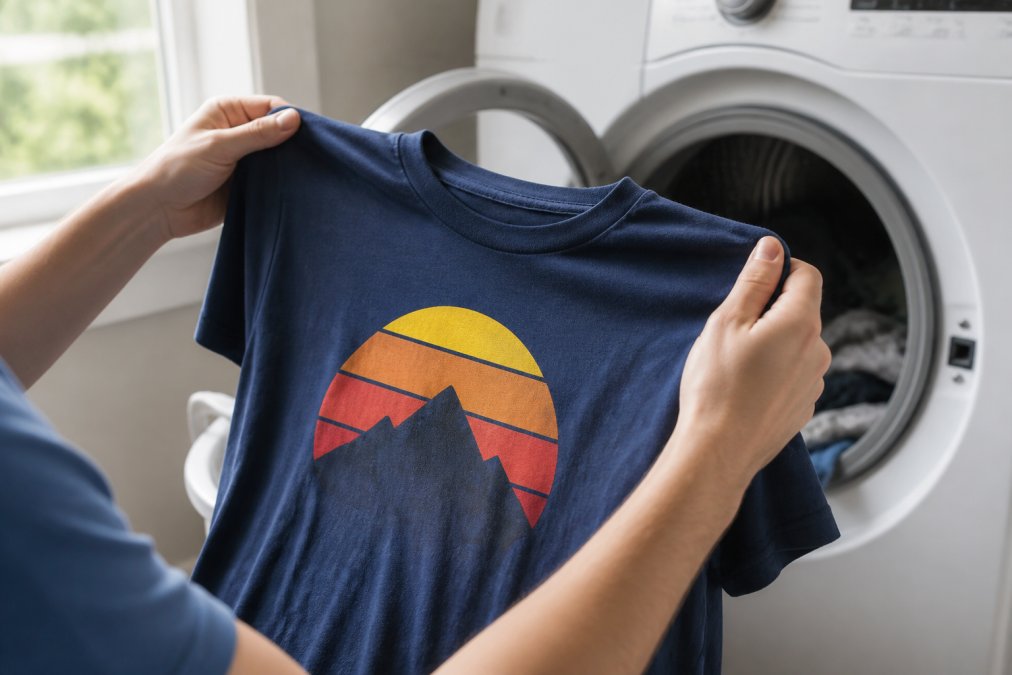
Durability is where budget vendors separate from quality ones. The leading cause of premature print failure is a weak ink-to-fabric bond, usually from a rushed cure or a low-quality transfer. A properly applied DTF print on 100% cotton can survive dozens of wash cycles without cracking, provided the garment is washed inside out in cold water (cleanclothes.org).
Post-wash longevity testing follows a simple routine. Wash the garment inside out in cold water, tumble dry low or hang dry, and inspect the print after every fifth cycle. Cracks appear first along the edges of the design, then spread inward. If a print cracks after three washes, the fault is in production, not in how you laundered it.
Watch Out
Never iron directly over a DTF or screen-printed logo. The heat melts the print and transfers ink to the iron. Iron the reverse side only.
Fabric weight matters here too. Heavier garments, in the 6-ounce range, hold their shape and support a print better than thin 4-ounce knits. The Textile Exchange materials guidance notes that fiber content and fabric construction both affect how a garment ages, which is why cotton-heavy blanks tend to outperform cheap blends over time.
Best Practices for Custom Apparel Design and Artwork Prep
Clean artwork is the single biggest factor in whether a print looks sharp or muddy. Vector artwork, saved as an AI, EPS, or high-resolution PDF file, scales without losing quality. Raster files like JPEGs and PNGs can work for DTF printing if they are at least 300 DPI at the final print size.
If your files are a mess, some services will clean them up. Redrawing a low-resolution logo into vector format can be routine work. The key is to ask before ordering, not after.
Artwork prep checklist:
- Confirm the file is vector or at least 300 DPI
- Convert all fonts to outlines
- Remove backgrounds and stray elements
- Check that logo colors match your brand guide
- Request a digital proof before production
Design proofing protects both sides. A proof shows exactly how the logo will sit on the garment, including size and placement. Approve it in writing before the run starts.
Pro Tip
Ask for the logo sized to the actual print dimensions, not scaled to fit a screen. A logo that looks right on a monitor can print far smaller than intended.
Pricing, Minimum Order Quantities, and Setup Fees
Custom apparel pricing is not a single number. It is the sum of four separate line items, and knowing which ones apply to your order is the difference between a quote that holds and one that balloons after proofing.
1. The blank garment. This is the largest line item and the one buyers fixate on. A 4-ounce budget knit and a 6-ounce ring-spun cotton tee can differ substantially in unit cost, and the heavier blank usually wins on cost per wear because it survives more laundering cycles without losing shape.
2. Setup and prep charges. Screen printing carries a setup fee per color because each color requires its own screen, and that screen must be burned, registered, and reclaimed. Embroidery carries a one-time digitizing charge that scales with stitch count, a simple one-color wordmark might run a few thousand stitches, while a detailed multi-color crest can run well past 10,000. DTF printing skips setup entirely, which is why it wins on small runs and one-off orders.
3. Decoration cost per unit. This is where volume pricing lives. Screen printing spreads the setup across the run, so the per-unit price drops sharply as quantity climbs. DTF and embroidery price more linearly, so the volume discount is gentler.
4. Placement count. A logo on the left chest is one placement. Add a full back print, a sleeve hit, or a name personalization and you have added line items, not a bigger version of the same one.
Minimum Order Quantities by Method
| Method | Typical Minimum | Setup Charge | Best Quantity Band |
|---|---|---|---|
| Screen printing | 12-24 pieces | Yes, per color | 48+ pieces |
| DTF / direct-to-garment | 1 piece | No | 1-47 pieces |
| Custom logo embroidery | 1-6 pieces | Yes, digitizing | Any, but best at 12+ |
A common pattern is a team that needs 10 shirts for a launch and 200 for a conference six months later. Ordering all 210 as screen print forces a large upfront commitment on a design that may change. Ordering the first 10 as DTF and the later 200 as screen print can keep the small run flexible and the large run cheap.
How to Compare Quotes That Look Different
Two vendors can quote the same job and land hundreds of dollars apart because they are pricing different things. When you compare, normalize every quote to the same four questions:
- Is the quoted price per piece or per order?
- Are setup, digitizing, and screen fees included or added at proof?
- Is shipping baked in or billed separately?
- Does the price assume a specific blank, or is the garment tier still open?
Key Takeaway
The lowest unit price is not the lowest cost. Divide total order cost by the number of wears you realistically expect, and the heavier blank with the better print usually wins.
At 2mepromo.com, a customized DTF shirt with your own logo starts at $15.00, and bulk orders such as 150 customized cotton shopping totes with a full-color logo run $498.00 with free setup and shipping. These prices reflect the brand's positioning for government agencies and small businesses.

U.S. Small Business Administration guidance on vendor selection
Custom Apparel Turnaround Time and Shipping Speed
Turnaround time is the make-or-break factor for event deadlines, and it is also the most misunderstood number in a quote. A vendor that says "two weeks" is usually quoting production only. The clock that matters starts when you place the order and stops when the box lands at your door.
The Five Stages Between Order and Delivery
- Artwork intake and review. The vendor checks your file for resolution, color mode, and printability. A clean vector file clears this in hours. A low-resolution JPEG that needs redrawing can add a day or more.
- Digitizing or screen prep. Embroidery logos must be converted to a stitch file. Screen-printed jobs need screens burned per color. This is the stage most likely to surprise first-time buyers.
- Digital proof and approval. You receive a mockup showing logo size and placement. Production does not start until you approve it in writing. Every day you sit on the proof is a day added to delivery.
- Production run. Decorating the garments. This is the number vendors usually quote.
- Packing and shipping. Boxing, labeling, and transit. Transit time depends on the carrier and the destination, not the decorator.
Typical Timelines by Method
| Method | Standard Production | Rush Available | Notes |
|---|---|---|---|
| DTF / direct-to-garment | 3-7 business days | Yes, often 1-3 days | No screen or digitizing prep |
| Screen printing | 7-14 business days | Yes, with rush fee | Add time per color |
| Custom logo embroidery | 7-14 business days | Yes, with rush fee | Digitizing adds 1-3 days on first order |
Repeat orders move faster than first orders because the screens or stitch file already exist. If you expect to reorder the same design, ask the vendor to keep the setup on file.
How to Plan Backward from an Event Date
Work backward, not forward. Start with the in-hands date, the day the garments must physically be in your possession, and subtract:
- Shipping transit (carrier-dependent; ground can run several business days coast to coast)
- Production time for your chosen method
- Proof approval time (assume one business day)
- Artwork prep time (assume one to three days if your file needs work)
- A buffer of at least one week for the unexpected
A common mistake is counting only the shipping window. Production, proofing, and shipping are three distinct stages, and each adds days. For a county fair or conference, build in a buffer of at least a week beyond the quoted delivery date.
Watch Out
A rush fee buys production speed, not shipping speed. If your event is three days out, no rush upgrade will help, the transit time alone will miss the date.
Reliable delivery depends on clear communication. A vendor that confirms your in-hands date in writing and flags any risk early is worth more than one that quotes the lowest price and misses the deadline. Ask for the in-hands date in writing, and ask what happens if the order runs late.
Top Picks from 2mepromo.com
The strongest options in the 2mepromo.com catalog cover the full range of custom apparel needs, from everyday staff shirts to formal embroidered outerwear.
Customized DTF Shirt with your own logo (product link, $15.00) is the best starting point for most teams. Upload your logo and text, and the service sizes the image and prints it. The 6-ounce, 100% US cotton body gives a soft-hand feel.
Gildan DTF 18500 Logo Hoodie (product link, $30.00) suits cooler-weather events and staff outerwear. The 8-ounce, 50/50 cotton/poly blend holds up to repeated wear, and the Safety Green colorway is compliant with ANSI/ISEA 107 high-visibility standards.
C301 Solid Color Flex Fit Hat (product link, $27.99) is the pick for custom logo embroidery on headwear. The Flexfit 110 technology allows for the perfect blend of Flexfit technology and adjustability for a more custom fit, and the Permacurv® bill maintains proper shape and curve.

Ladies Fairway Stretch 1/4 Zip (product link, $49.99) rounds out the lineup for corporate and agency wear. The cotton-rich jersey with spandex allows for easy movement, and the covered zipper placket gives a clean look.

| Product | Price | Best For | Decoration |
|---|---|---|---|
| Customized DTF Shirt | $15.00 | Everyday staff shirts | DTF print |
| Gildan DTF Hoodie | $30.00 | Cool-weather events | DTF print |
| C301 Flex Fit Hat | $27.99 | Headwear branding | Embroidery |
| Ladies Fairway 1/4 Zip | $49.99 | Corporate wear | Embroidery |
Conclusion: Choosing the Right Custom Apparel Partner
The hard part of custom apparel is not picking a logo. It is finding a partner that gets the print method, the artwork, and the deadline right on the first order. 2mepromo.com offers tailored solutions for government agencies and small businesses, personalized branding support from an expert team, and a catalog that spans custom apparel, signage, and promotional items. Get started with 2mepromo.com and put branded garments in your team's hands without the guesswork.
Frequently Asked Questions
How long does custom apparel turnaround time usually take?
Turnaround time depends on the decoration method and order size. Bulk orders may take longer. Always confirm the production schedule in writing before placing your order, and factor in shipping transit time so your apparel arrives before your event date.
What factors define high-quality custom apparel?
Four factors matter most: print durability after repeated washing, color accuracy against your brand guidelines, fabric weight and feel, and consistent placement across every garment. High-quality custom apparel also holds its shape and ink vibrancy over time. Check whether the provider offers design proofing so you can catch issues early.
What is the difference between screen printing and embroidery for custom apparel?
Screen printing presses ink through a mesh stencil, which suits bold graphics and large runs at a lower per-unit cost. Custom logo embroidery stitches thread directly into the fabric, giving a raised, professional look that works well on polos, hats, and outerwear. Embroidery has a higher setup cost because your logo needs digitizing, but the result lasts the life of the garment. Choose based on garment type, logo detail, and order volume.
How much does it cost to get custom clothes made?
Pricing depends on garment, decoration method, and quantity. At 2mepromo.com, DTF-printed shirts start at $15.00, a Gildan Dryblend Polo is $29.99, and a Gildan hoodie with a DTF logo is $30.00. A 150-piece custom cotton tote order runs $498.00 with free setup and shipping. Bulk orders lower the per-unit cost, and some items include free setup, so always request a quote for your specific combination.
How can small businesses ensure consistency in custom apparel orders?
Lock down your artwork files first. Supply vector artwork or a high-resolution PNG so the provider works from a clean source every time. Approve a digital proof before production, and keep a record of ink colors, thread colors, and logo placement measurements. Reorder from the same provider using that saved specification sheet. Consistency breaks down when each order starts from a different file or a different vendor.
- Choosing a selection results in a full page refresh.
