Your cart is empty
Looks like you haven't added anything to your cart yet







How to Store and Transport Bulk Promotional Drinkware Safely
Last Updated: November 5, 2026
Quick Summary
Check the carton count against the packing slip and inspect a sample from each carton as soon as a bulk promotional drinkware order arrives. Then wrap each piece by material, fill every void so cartons cannot shift, and load the heaviest cartons first and low in the vehicle.
- Compare carton counts to the packing slip and note any mismatch on the delivery paperwork before the driver leaves.
- Wrap glassware and ceramic mugs individually, covering rims and handles, and stand them upright in dividers.
- Wrap stainless steel bottles in soft sleeves and pack their lids separately to prevent scratches.
- Fill voids completely, tape all seams, and mark fragile cartons on at least two sides.
- Keep drinkware off the floor and away from chemicals or strong odors in a dry, stable storage area.
Table of Contents
- Receiving and Checking a Bulk Drinkware Order
- Packing Bulk Promotional Drinkware by Material and Shape
- How to Transport Tumblers and Cups Without Breakage
- Bulk Promotional Drinkware Storage Conditions and Layout
- Drinkware Inventory Organization and Labeling
- Palletizing, Loading, and Event-Day Distribution
- Scheduling Your Next Drinkware Order and Delivery
- Frequently Asked Questions
Receiving and Checking a Bulk Drinkware Order
When a bulk order arrives, the first hour matters most. Check the carton count, the packing slip, and the outer boxes before you sign for anything.
Start with a simple count. Compare the number of cartons against the packing slip. Then open a few boxes at random and count the units inside. If the counts do not match, write it on the delivery paperwork before the driver leaves.
Next, inspect a sample from each carton. Look for:
- Cracked or chipped glassware and ceramic rims
- Dents or scratches on stainless steel bottles and tumblers
- Decoration that is off-center, smudged, or peeling
- Lids that do not seat or seal properly
Set aside any damaged units in a separate, labeled bin. Take photos of the damage and the carton labels. These photos support a claim if you need one. A short written log with dates and quantities works well for this step.
Plan for storage space before the truck arrives. A pallet of drinkware takes up more room than most teams expect, so clear a dry, flat area first. Keep the order sealed until you are ready to pack or distribute it.
Packing Bulk Promotional Drinkware by Material and Shape
Different materials need different protection. Glass breaks, ceramic chips, and stainless steel dents or scratches. A packing method that works for one can fail for another, so group your inventory by material before you start. Adjust carton counts to your own box sizes and carrier limits.
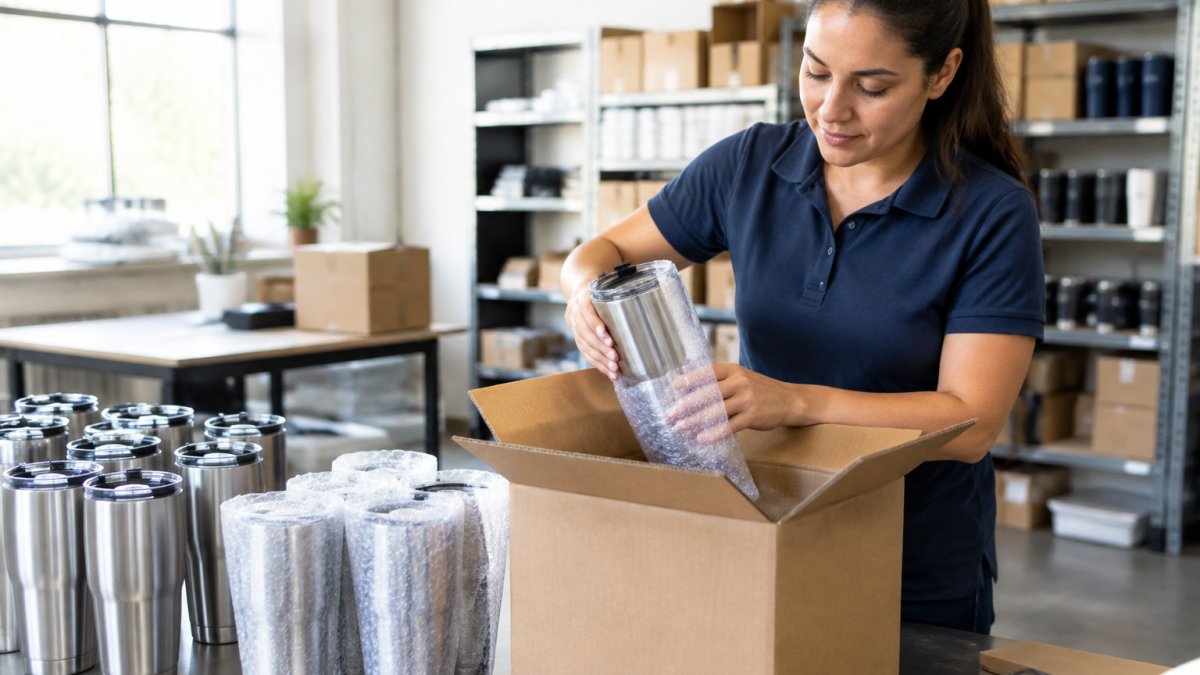
Pack heavier, sturdier items at the bottom of each carton. Place lighter, more fragile items on top, with protective layers between them. Never let two hard surfaces touch directly. Keep the carton's top layer flat so the next carton stacks evenly.
Packing Glassware and Ceramic Mugs
Glassware and ceramic mugs are the most likely items to break in transit. Wrap each piece individually in bubble wrap or a padded sleeve, and make sure the wrap covers the rim and handle, since these are the weakest points.
Stand mugs upright and place them in dividers or cell inserts. If you do not have dividers, use a layer of padding between every row and offset the mugs so handles do not line up and press against each other. Fill empty space with padding so nothing shifts when the box is lifted.
For glassware, pack stemware and tumblers separately. Wrap stems with extra padding and stand them upright; laying stemware on its side concentrates stress at the stem joint. Label the carton with the item type and quantity so the team knows what to expect when it is opened.
Protecting Stainless Steel Bottles and Tumblers
Stainless steel is tougher than glass, but it still scratches and dents. Wrap each bottle or tumbler in a soft sleeve or a sheet of protective film before boxing. This keeps the printed or engraved finish clean and prevents metal-on-metal scuffing.
Remove lids before packing and bag them separately. This prevents the lid threads from scratching the bottle body and keeps small parts from getting lost. Pack bottles upright in a single layer where possible; if you must stack, put a rigid divider between layers so the weight does not rest on the lids.
Packing Plastic Cups and Bottles
Plastic is the most forgiving material, but it still cracks under point pressure and can scuff. Bag plastic cups in sleeves or poly bags rather than loose-filling the carton, and keep the carton fill tight so cups do not rub against each other. Stack cups in nested columns with a cardboard divider between columns. Plastic bottles can be packed upright in a single layer with a light layer of padding between rows.
If you use the 17 ounce water bottle CECO TAX DEDUCTIBLE, note that its PC body is durable but not fall proof. Pack it with extra cushioning so it does not take a hard drop during handling. Learn more about this option at 17 ounce water bottle CECO TAX DEDUCTIBLE, and compare with Stainless Steel Water Bottle for packing and transport planning.


Carton Fill and Labeling Rules That Apply to Every Material
- Fill voids completely; a carton should not shift when tilted.
- Keep the heaviest items centered over the base, not against one side.
- Tape all seams, including the bottom, with a continuous strip.
- Label each carton with material, item number, quantity, and destination.
- Mark fragile cartons on at least two sides so handlers see the warning from either direction.
The table below summarises how each material should be packed, using the guidance from this section.
| Material | Main risk | Packing method |
|---|---|---|
| Glassware and ceramic mugs | Breakage | Wrap each piece, stand upright in dividers |
| Stainless steel bottles and tumblers | Scratches and dents | Sleeve each piece, pack lids separately |
| Plastic cups and bottles | Cracks and scuffs | Bag cups, keep carton fill tight |
| Any carton | Shifting in transit | Fill voids, tape all seams |
How to Transport Tumblers and Cups Without Breakage
Transport is where most breakage happens. Vibration, sudden stops, and stacked weight all put stress on packed boxes. Good packing helps, but how you load the vehicle matters just as much.
Load the heaviest cartons first and place them against the wall of the vehicle. Keep the load low and centered. Fill any gaps with padding or empty boxes so cartons cannot slide during transit.
Follow these habits on every trip:
- Secure the load with straps or a cargo net
- Keep boxes off the floor when the vehicle has a damp or uneven surface
- Avoid stacking more than the carton rating allows
- Never place drinkware under heavy items such as tools or equipment
Check the load at every stop. A quick look at the corners and the top layer can catch a shifted box before it causes damage.
Bulk Promotional Drinkware Storage Conditions and Layout
Storage conditions affect the finish and the packaging of bulk drinkware. Humidity can soften cardboard and cause labels to lift. Extreme heat can weaken some protective films. A stable, dry, and clean space protects your inventory until it is needed.
17 ounce water bottle CECO TAX DEDUCTIBLE →
Aim for a room that stays dry and at a steady temperature. Keep cartons off the floor on pallets or shelving to protect them from moisture and dust. Do not store drinkware near chemicals, cleaning supplies, or strong odors, since those can transfer to food-contact surfaces.
Arrange the storage area by product type and event date. Put the items you ship first near the door. Leave an open aisle so you can reach any carton without moving the others. Clear labeling on each shelf makes restocking faster and reduces handling damage.
Drinkware Inventory Organization and Labeling
Clear labels save time and prevent mistakes. Use a consistent system for every carton, shelf, and bin.
Each label should include:
- Product name and item number
- Quantity inside the carton
- Material type, such as glass, ceramic, or stainless steel
- Event or customer name, if the stock is already committed
- Date received
Use a simple spreadsheet or inventory tool to track stock levels. Update it every time a carton leaves the storage area. A running count helps you reorder before you run short.
Many teams find that a color code works well. Assign one color to each material and another to each event. Staff can then spot the right carton at a glance, even during a busy event setup.
Palletizing, Loading, and Event-Day Distribution
For large shipments, palletizing gives you the most stable and efficient setup. Build each pallet with the heaviest cartons on the bottom and an even stack.
Keep the load square and centered on the pallet, and do not let cartons overhang the edges. Check your carrier's height and weight limits before you build. Label each pallet with its contents and destination so the crew does not need to open cartons to find what they need.
Loading the Vehicle
Load the heaviest pallets and cartons first and place them against the front wall of the vehicle. Keep the load low and centered over the axles. Fill any gaps with padding or empty boxes so cartons cannot slide during transit.
Follow these habits on every trip:
- Secure the load with straps or a cargo net rated for the load weight
- Keep boxes off the floor when the vehicle has a damp or uneven surface
- Avoid stacking more than the carton rating allows
- Never place drinkware under heavy items such as tools or equipment
- Check the load at every stop; a quick look at the corners and the top layer can catch a shifted box before it causes damage
Event-Day Distribution and Handoff
On event day, plan distribution before the crowd arrives. Set up a table or station with the labeled cartons close at hand. Assign one person to hand out items and one person to restock the table.
Use a short handoff checklist so the count and condition are confirmed at each stage:
- Confirm the count against the event order before unloading.
- Inspect the top layer of each pallet for crush or shift damage.
- Unpack only what the station needs; keep the remaining stock sealed and labeled.
- Log every unit handed out and note any damaged units set aside.
- Pack leftover stock with the same care used at the start, and record the return count.
Logging each unit gives you accurate records for future orders and helps you see which items move fastest. Keep the log with the pallet labels so the next event's crew can see what was shipped, what was handed out, and what came back.
Scheduling Your Next Drinkware Order and Delivery
Plan your next order based on what you learned from this one. Note which items arrived damaged, which sold out early, and which sat unused. These patterns show you what to order more or less of next time.
Set a timeline that works backward from your event date. Allow time for production, shipping, inspection, and storage setup. A delivery that arrives the week before an event leaves little room to fix problems.
For guidance on delivery timelines, read Promotional Product Delivery Time Expectations: 2026 Guide. Use the Promotional Product Quality Assurance Checklist 2026 to check each delivered batch before it goes into storage. If you are planning future events, Bulk Custom Water Bottles for Events: 2026 Guide can help you choose products and timing.
Good planning turns a stressful delivery into a routine. Keep your records, refine your process after each order, and you will spend less time fixing breakage and more time putting drinkware in front of the people who will use it.
Frequently Asked Questions
Should cups be stored facing up or down?
Store cups facing down or upside down on shelves or in cartons so dust, moisture and odors do not collect inside. Stacking should be kept to a safe height so the lower pieces do not crack or chip. For glass and ceramic items, place a protective layer between each piece so rims do not touch. Facing down also helps you verify quickly that the stack is clean before event distribution.
Should glasses be packed standing up or lying down?
Glassware is generally safer packed upright, in its own compartment, with each piece wrapped and cushioned on all sides. Lying glasses down can concentrate pressure on the rim and stem during transport. Using dividers in a carton keeps each piece upright and prevents shifting. Mark the box so handlers know which way it should be kept during loading and unloading.
What packing materials help protect promotional tumblers during shipping?
Protect each tumbler during transport and keep it from shifting inside the carton. Fill empty space in the carton to limit shifting during transport. Seal the carton well and label it clearly for your event team.
How should you organize drinkware cartons for faster event setup?
Label each carton with the product and quantity, and keep cartons for the same event together. Create a simple checklist of cartons so your team can confirm everything is loaded before the vehicle leaves.

- Choosing a selection results in a full page refresh.
