Your cart is empty
Looks like you haven't added anything to your cart yet







7 Lanyard Attachment Types for ID Badges Explained
Last Updated: November 16, 2026
Quick Summary
Lanyard attachments are the metal or plastic hardware pieces that connect a neck strap to an ID badge holder, and the right choice depends on three things: your badge format, how often you remove it, and where you wear it. Match the clip to the holder first, then confirm breakaway or non-breakaway by environment.
- A swivel hook rotates so the badge spins freely, while a lobster-claw hook opens one-handed for frequent removal.
- Use a split ring only with a punched hole, never forced through a slot, or the holder will crack.
- Choose breakaway lanyards near moving equipment or the public, and non-breakaway where badge security matters more.
- Inspect spring gates and webbing quarterly, and tighten to monthly checks in dusty or damp environments.
- Standardize on one or two attachment types per wearer group and keep a small buffer of spares on hand.
Not sure which clip your badge needs?We match lanyard attachments to your badge format and workplace, then print them with your brand.
Shop Lanyard Attachments
Table of Contents
- The 7 Lanyard Attachment Types and What Each One Does
- How to Match an ID Holder for Lanyard Use to the Right Clip
- Lanyard Badge Holder Formats: Slot, Punched Hole, and Armored
- When Retractable Lanyards for ID Badges Beat a Fixed Strap
- Breakaway vs. Non-Breakaway: Safety Guidance by Environment
- The Best Lanyard for ID Badges: A Decision Matrix by Task and Wearer
- Care, Replacement, and Lifecycle Costs of Lanyard Attachments
- Ordering Custom Lanyard Attachments for Your Team
- Frequently Asked Questions
The 7 Lanyard Attachment Types and What Each One Does
Choosing the right hardware for lanyard attachments comes down to one question: how does your ID badge need to move during a shift?
Below, we break down all seven types, then show you how to match each one to a holder, a wearer, and a workplace.
Swivel Hooks and Lobster-Claw Hooks
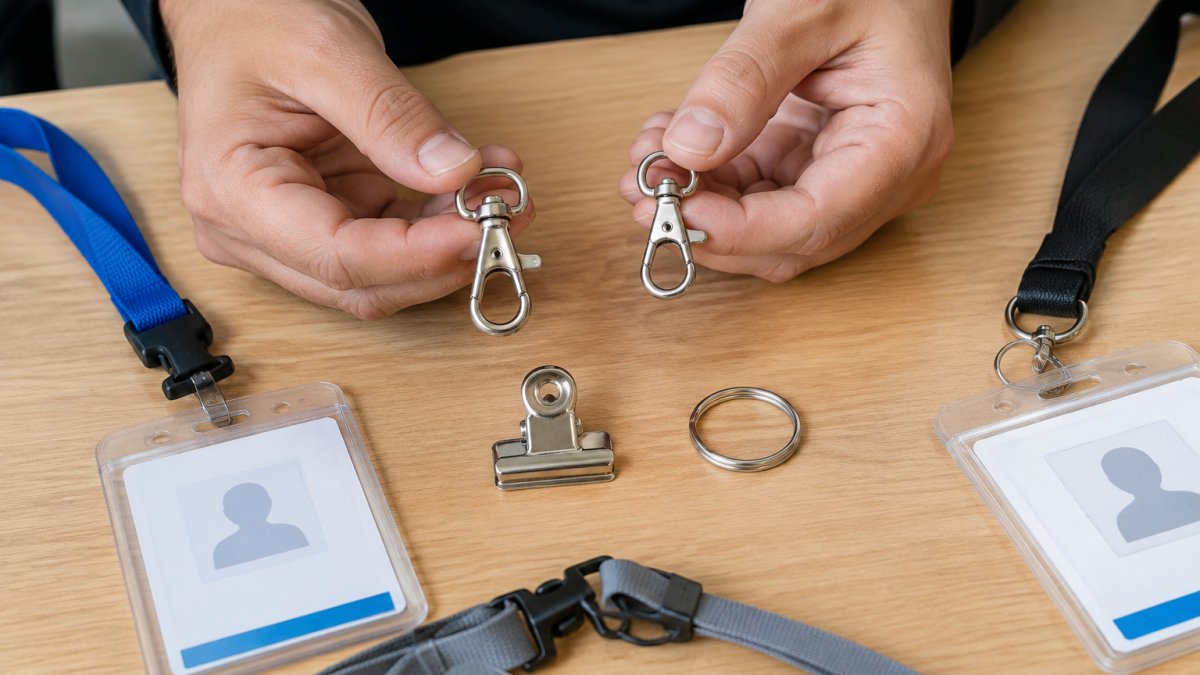
A swivel hook is a rotating clasp that lets the badge spin freely, while a lobster-claw hook is a spring-loaded clip you squeeze to open. Both are the default choice for daily-wear ID cards.
The swivel version wins when your badge needs to flip around, like a card you tap on a reader. The lobster-claw version wins when you remove the badge often, because the spring gate opens one-handed. What most guides miss is the wear factor: cheap lobster claws lose tension after months of squeezing. Buy hardware rated for repeated open-and-close cycles.
Bulldog and Alligator Clips
Bulldog and alligator clips grip fabric or a card edge with a flat, toothed jaw. They work well for badge holders without a slot or hole. The trade-off is real: the teeth can snag knit shirts and lanyard webbing over time. Reserve these for visitors, temp staff, or clip-on badges that stay put all day.
Split Rings and Key Rings
A split ring is a continuous metal loop that threads through a punched hole and rarely comes loose. It is the most secure attachment in the group and the least convenient. Expect to use two hands and a fingernail to swap a card. For permanent staff badges that never leave the strap, that is a fair trade.
How to Match an ID Holder for Lanyard Use to the Right Clip
Match the clip to the holder before anything else. An ID holder for lanyard use comes with one of three connection points, and the hardware must fit that point exactly.
Run this compatibility check:
- Does the holder have a slot at the top? Use a swivel hook or lobster claw.
- Does the holder have a punched hole? Use a split ring or key ring.
- Is the holder armored or rigid? Use a bulldog clip or a short strap adapter.
- Does the card need to be scanned or tapped without removal? Add a retractable reel.
- Will the wearer remove the badge many times a day? Favor a spring clip over a ring.
The mismatch we see most often is a split ring forced through a slot. It fits, but it wears the plastic edge until the holder cracks.
Lanyard Badge Holder Formats: Slot, Punched Hole, and Armored
A lanyard badge holder is only as good as its connection point, and the connection point is where most badge failures start. Slot holders are the most common and the easiest to clip. Punched-hole holders suit split rings and key rings.
The format matters because each one fails differently. A slot is a molded opening in vinyl or plastic; repeated pull from a heavy card widens it until the clip slips through.
Run this fit check before you pair a holder with hardware:
- Hole and slot size: A split ring needs a punched hole wide enough to thread without forcing. A swivel hook or lobster claw needs a slot with a lip the hook can seat behind. If the hook rattles loosely in the slot, it will work its way out.
- Holder orientation: Vertical holders hang the card portrait-style, which suits most access cards and photo badges. Horizontal holders present a wider face, which helps when a barcode or magnetic stripe needs to face a scanner. Match orientation to how the card is read, not to how it looks.
- Card weight: A thin vinyl holder flexes under a heavy access-control card and pulls the slot open. If the card is thick or carries a chip, choose a rigid or armored holder rated for that weight.
- Reader clearance: A clip or ring that sits in front of a barcode, chip, or contactless antenna can block a scan. Test the assembled badge against the actual reader before you order in bulk. A short strap adapter that offsets the card from the hardware often solves this.
- Attachment dimensions: A bulky bulldog clip on a slim holder overhangs the edge and catches on pockets and doors. Match the hardware footprint to the holder width.
Watch out: the mismatch we see most often is a split ring forced through a slot. A secure reader check also depends on durable attachment materials that keep the badge stable through daily wear, a concern shared by Barkers Creative Designs.
When Retractable Lanyards for ID Badges Beat a Fixed Strap
Retractable lanyards for ID badges win whenever the wearer swipes, taps, or scans constantly. The reel extends the card to the reader and pulls it back, so nobody unclips anything. For access control doors, point-of-sale terminals, and barcode scanners, that motion saves real time across a shift.
Fixed straps win for everything else. They cost less, break less, and never jam. A retractable reel adds a moving part, and moving parts fail. Use reels where the task demands reach. Use a fixed strap where the badge just needs to be visible.
Breakaway vs. Non-Breakaway: Safety Guidance by Environment
A breakaway lanyard releases under tension so the strap cannot become a choking or snag hazard. A non-breakaway lanyard stays intact and holds the badge securely.
Match the choice to the environment:
| Environment | Recommended | Why |
|---|---|---|
| Office, reception, retail floor | Breakaway | Snag and pull safety around desks and fixtures |
| Warehouse, loading dock | Breakaway | Machinery and conveyor snag risk |
| Healthcare, patient contact | Breakaway | Grabbing and pulling incidents |
| Secure facility, controlled access | Non-breakaway | Prevents badge loss and tailgating |
| Food processing, clean rooms | Non-breakaway | Keeps badge inside the controlled zone |
As a general guide: if the wearer is near moving equipment or the public, choose breakaway. If badge security matters more than snag risk, choose non-breakaway. The OSHA guidance on workplace hazards treats entanglement as a genuine hazard, not a formality.
The Best Lanyard for ID Badges: A Decision Matrix by Task and Wearer
The best lanyard for ID badges is the one matched to the daily task, not the one that looks best in a catalog. Use this matrix to decide in under a minute.
| Wearer or task | Attachment | Holder format | Lanyard type |
|---|---|---|---|
| Front desk, frequent taps | Swivel hook + reel | Slot | Breakaway |
| Warehouse staff | Lobster claw | Slot | Breakaway |
| Permanent staff, no removal | Split ring | Punched hole | Non-breakaway |
| Visitors and temps | Bulldog clip | Clip-on | Breakaway |
| Healthcare, patient contact | Lobster claw | Slot | Breakaway |
| Secure facility | Split ring | Punched hole | Non-breakaway |
Consider accessibility and wearer needs. A wearer with limited hand strength may find a lobster claw easier to use than a split ring. A wearer who uses a wheelchair may need an adjustable strap length so the badge sits at a comfortable height. Ask before you order.
Care, Replacement, and Lifecycle Costs of Lanyard Attachments
Hardware fails in predictable ways, and knowing the failure points saves money and prevents badge loss. Spring clips lose tension as the gate cycles. Split rings bend open under repeated pull.
A simple care routine extends life:
- Wipe metal hardware with a dry cloth monthly to clear skin oils and grit.
- Keep reels away from lint-heavy pockets and bags, and pull the cord straight rather than at an angle.
- Inspect spring gates for looseness every quarter by opening and closing them a few times.
- Check webbing at the clip contact point for fraying each quarter.
- Replace any clip that opens under light pull or any ring that has bent out of round.
Inspection intervals should tighten with the environment. A warehouse or food-processing floor exposes hardware to dust, moisture, and repeated snags, so monthly checks are reasonable.
Lifecycle cost can matter more than unit price, since hardware that fails often adds replacement and downtime costs. For a structured way to compare, use this total cost of ownership framework. If you are vetting suppliers on durability, run them through this quality assurance checklist before you commit to a bulk order.
Watch out: a reel that jams mid-shift often gets yanked, which damages the cord and the housing.
Ordering Custom Lanyard Attachments for Your Team
Bulk orders go wrong for boring reasons: wrong clip, wrong holder, wrong deadline. Get the specs locked first, then order.
Before you request a quote, confirm:
- Badge format for every wearer group
- Attachment type per group from the matrix above
- Breakaway or non-breakaway by environment
- Lanyard width, color, and printing method
- Quantity per department, with a small buffer
- Delivery date with at least a week of slack
Customization choices can affect lead time, so confirm timing early. Read this guide to promotional product delivery timelines before you set an event date. When you are ready to buy, this guide on where to order custom lanyards for events walks through the bulk order process. And if you are choosing a supplier, verify vendor reliability first.
Most teams treat badge hardware as an afterthought, then spend the year replacing cracked holders and dead reels. The fix is a five-minute conversation about badge format, removal frequency, and workplace hazards before the order goes out. 2mepromo.com offers tailored solutions for government agencies and small businesses, along with custom-made promotional products and branding support.
Frequently Asked Questions
Which lanyard attachment works best with a badge holder?
A swivel hook or lobster-claw hook is the safest default for a standard vinyl badge holder. Both clip through the holder's top slot and rotate freely, so the ID card stays readable and the strap does not twist. If the holder has a reinforced punched hole instead of a slot, a split ring spreads the load and resists tearing. Match the clip to the attachment point first, then to how often the wearer removes the badge.
When should you choose retractable lanyards for ID badges?
Choose a retractable reel when the wearer swipes, taps, or scans a card many times a day at access control readers, turnstiles, or point-of-sale terminals. The cord extends so the badge reaches the reader without the strap coming off, then retracts out of the way. Skip reels in food handling, industrial, or clinical settings where a dangling cord can catch on equipment or create a hygiene problem.
Can you put badges on a lanyard without a holder?
Yes, if the card has a punched hole, a split ring or key ring threaded through the hole works without any holder. Cards with only a magnetic stripe or proximity chip and no punched hole need a holder or a badge clip instead. Before ordering, check whether your access cards are pre-punched, because punching a hole in a proximity card after issue can damage the antenna inside and stop it from reading.
What is the best lanyard for ID badges in a workplace with moving machinery?
Use a breakaway lanyard with a short, flat strap and a low-profile clip, and avoid retractable cords and long dangling attachments. Breakaway clasps release under load so the lanyard cannot pull a wearer into equipment or become a strangulation risk. Confirm the breakaway point sits at the back of the neck, and check with your safety officer whether your site rules require a specific attachment style before you place a bulk order.

- Choosing a selection results in a full page refresh.
