Your cart is empty
Looks like you haven't added anything to your cart yet







Where to Buy Custom Lanyards for Events (2026 Guide)
Table of Contents
- What to Look for Before You Order Custom Lanyards
- Comparing Custom Lanyard Material Types
- Choosing the Right Lanyard Attachment Styles
- How to Get the Best Bulk Lanyard Pricing
- Understanding Turnaround Time for Promotional Lanyards
- Design Tips for Readable, Professional Event Lanyards
- Where to Buy: Choosing a Vendor That Delivers on Time
- Conclusion
- Frequently Asked Questions
Last Updated: September 8, 2026
Event planners and procurement teams searching for where to buy custom lanyards for events often discover that the cheapest quote rarely delivers the polished result their brand deserves. Finding a partner who understands material quality, production timelines, and design constraints requires more diligence than a simple price comparison. The difference between a successful order and a stressful one usually comes down to preparation before you ever submit artwork.
Below, we'll walk through the critical decisions that determine whether your custom lanyards arrive on time, look sharp, and hold up through a full day of conference wear.
What to Look for Before You Order Custom Lanyards
The most important step happens before you browse any catalog: defining your event's specific requirements. Custom lanyards serve as both functional ID holders and walking billboards for your brand, so clarity on quantity, durability needs, and security features shapes every subsequent decision.
Start by asking how your lanyards will be used. A one-day trade show demands different specifications than a multi-day conference where staff wear lanyards continuously. Consider audience size, badge weight, and whether you need breakaway safety features for environments where snagging poses a risk.
Budget and timeline narrow your options immediately. Bulk pricing rewards larger orders, but only if you need the volume. Rush production carries trade-offs in cost and customization methods, so knowing your hard deadline prevents last-minute compromises.
Comparing Custom Lanyard Material Types
The material you select is the single largest factor in your lanyard's environmental footprint, durability, and print quality. Most vendors list the standard polyester, nylon, and woven options but rarely explain trade-offs in a way that aligns with CSR goals or specific event environments.
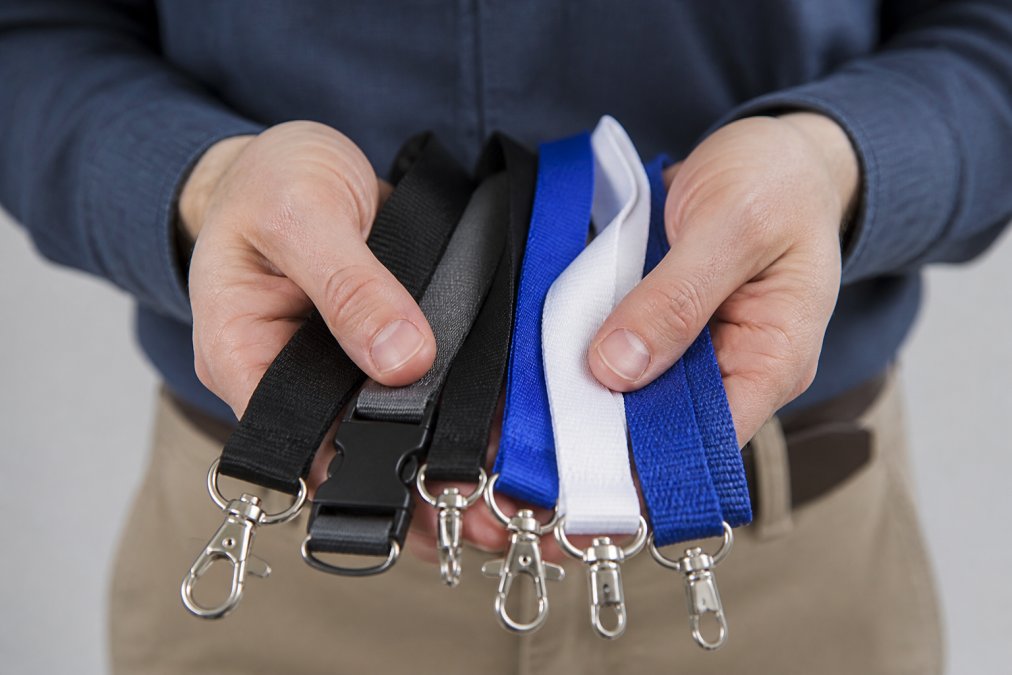
The Standard Three (and Their Real Trade-offs)
- Polyester: The industry workhorse. It offers a smooth, tight weave that is ideal for full-color dye-sublimation printing, making it the default for vibrant, photographic logos. However, standard polyester is a petroleum-based plastic. For a one-day trade show, it is a cost-effective choice. For a week-long conference where lanyards are worn continuously, it can become rough and fray at the edges.
- Nylon: Often chosen for its slightly glossier, more premium feel and higher tensile strength. It is more resistant to abrasion and moisture, making it a better choice for outdoor events or environments where lanyards might get wet. The trade-off is a higher per-unit cost and a surface that can resist ink absorption, sometimes requiring a more expensive printing process like heat transfer to achieve sharp results.
- Woven: The design is created by weaving colored threads into the fabric itself. This produces a textured, durable result that will not crack, peel, or fade. It is the premium choice for client-facing staff or multi-year use. The constraint is color count, woven lanyards are best with simple, 1-3 color logos, and a longer production time.
Claiming the Sustainability Gap: Recycled PET (rPET) and Organic Options
A significant gap in most competitor content is the absence of eco-friendly alternatives. For event planners under CSR mandates, this is a critical omission. A common option is Recycled PET (rPET) , plastic derived from recycled water bottles, which performs nearly identically to virgin polyester but allows you to market your event as using post-consumer waste.
When evaluating eco-claims, ask the vendor for specifics:
- What is the exact percentage of recycled content? Some vendors label a lanyard as "eco" with only 50% rPET.
- Is the printing process also eco-friendly? Look for water-based inks or dye-sublimation processes that don't use harmful solvents.
- Are the attachments (clips, hooks) also made from recycled or biodegradable materials? A recycled lanyard with a virgin plastic clip undermines the sustainability story.
For a unique, high-end feel, some suppliers offer lanyards made from organic cotton or bamboo, which have a natural, matte texture. They are less durable than nylon or polyester for heavy industrial use but are excellent for VIP gift bags, speaker gifts, or events with a strong environmental theme.
A Decision Framework for Material Selection
To move beyond guesswork, use this framework based on your event's specific demands:
- Event Duration & Frequency: A 4-hour trade show vs. a 3-day conference vs. an annual multi-day summit. Longer and more frequent use demands more durable materials like nylon or woven.
- Environmental Mandate: If your organization has a public sustainability goal, rPET is the baseline. Ask for the recycled content percentage and ensure it's verifiable.
- Print Complexity: Full-color gradients and photographs require the smooth surface of polyester or rPET. Simple logos can be woven or screen-printed on any material.
- Tactile Experience: The lanyard is a physical touchpoint. A soft, matte finish (polyester) feels different from a slick, technical one (nylon). Choose the feel that matches your brand's personality.
Pro Tip
When requesting a quote, explicitly ask for the recycled content percentage and the material weight (e.g., 180 GSM polyester vs. 220 GSM nylon). A heavier GSM (grams per square meter) indicates a denser, more durable, and more premium-feeling lanyard.
Choosing the Right Lanyard Attachment Styles
The attachment is the critical interface between your attendee and their credential. A failure here means a lost badge, a security breach, or a safety incident. Two areas are severely under-served by most vendor guides: safety standards for breakaways and integration with digital event technology.
The Functional Basics (and When to Use Them)
- Swivel Hook (or Key Ring): The most common and cost-effective option. The swivel prevents the badge from twisting and tangling the lanyard. Best for lightweight, single-card credentials at conferences and trade shows.
- Bulldog Clip: Offers a strong, firm grip for thick, laminated badges or multiple cards. It is a better choice for events where attendees are moving quickly and need to present their badge frequently.
- Badge Reel: A retractable cord housed in a plastic case. This is the professional standard for security personnel and staff who need to scan badges frequently without removing them. The reel keeps the badge at a consistent, accessible position.
The Critical Gap: Breakaway Safety Standards
A standard lanyard is a strangulation hazard. For events with children, in school settings, or in any environment with machinery (factory tours, industrial expos), a non-breakaway lanyard is a liability. The industry-standard solution is a breakaway or safety release buckle.
Not all breakaways are created equal.
- Magnetic Breakaways: These use a magnetic clasp that separates with a firm tug. They are convenient and easy to reattach. However, they can be accidentally released by strong magnetic fields or heavy badges.
- Plastic Snap-Apart Buckles: These use a mechanical snap-fit. They require a specific amount of force to separate, which is more predictable than a magnet. They are the preferred choice for environments where accidental release is a problem but safety is paramount.
When specifying a breakaway, ask the vendor for the release force rating. A common standard is release under approximately 5 to 10 pounds of force (the CDC). For a school or public event with minors, explicitly request a breakaway that meets this specification; do not assume a "breakaway" option is automatically compliant.
Claiming the Digital Gap: NFC and RFID Integration
The physical lanyard is becoming a critical component of the digital event ecosystem. If your event uses NFC (Near Field Communication) or RFID (Radio-Frequency Identification) for access control, cashless payments, or lead retrieval, the attachment style is your point of failure.
There are two primary integration methods:
- The Badge Holder: The most common method is to place an NFC or RFID chip inside a rigid plastic badge holder. In this case, the attachment needs to be a swivel hook or bulldog clip that can support the weight of the holder without breaking. A badge reel is often preferred here to allow for quick scanning.
- The Lanyard-Embedded Chip: A more advanced and less common approach is to weave an NFC chip directly into the lanyard's fabric. This allows attendees to tap their lanyard, rather than a separate card, at checkpoints. If you are considering this, you must choose a flat, non-abrasive attachment that won't interfere with the chip's location in the strap. A bulky bulldog clip near the chip can sometimes cause interference.
A Decision Checklist for Attachments
Before you finalize your order, run through this checklist:
- Safety First: Will the event host minors or occur near machinery? If yes, a breakaway with a specified release force is non-negotiable.
- Digital Integration: Will you use NFC/RFID? If so, determine if the chip is in the card or the lanyard. This dictates whether you need a badge reel for frequent scanning or a simple hook.
- Badge Weight: A heavy, multi-page badge booklet will pull and distort a cheap swivel hook. Match the hardware strength to the credential weight.
- Reusability: For multi-day events, a more durable attachment like a metal swivel hook or a high-quality badge reel will survive the week without breaking, saving you replacement costs.
Watch Out
Never assume a "breakaway" lanyard is safe for all environments. Always ask for the specific release force mechanism (magnetic vs. snap) and its rated force in pounds. For events with children, verify that the lanyard meets the general safety guidelines for preventing strangulation, which typically require the clasp to release under a relatively low amount of tension.
How to Get the Best Bulk Lanyard Pricing
Bulk lanyard pricing follows a familiar volume discount curve, but real savings come from understanding how vendors structure quotes. Most suppliers offer tiered pricing where per-unit costs drop at quantity thresholds, so ordering 500 units instead of 250 can sometimes cost only marginally more overall.
Beyond quantity, setup fees for creating the initial print template may apply, though some vendors waive these for larger quantities. The printing method also matters: screen printing offers cost efficiency for simple designs, while dye-sublimation delivers full-color photographic quality at a higher price point.
Custom artwork complexity affects pricing as well. Simple one-color logos are the most economical, while designs requiring precise color matching or intricate detail push costs upward. Requesting a design proof before committing allows you to verify the artwork translates well to your chosen material and printing method.
Understanding Turnaround Time for Promotional Lanyards
Turnaround time varies significantly based on the production method and your vendor's current workload. Standard production typically requires one to two weeks, plus shipping time (sba.gov). Rush production can compress this window, but expect to pay a premium.
The printing method directly influences production speed. Screen printing is generally faster for simple designs, while dye-sublimation and woven production require more time. Factor in design proof approval time as well, every day your team takes to review artwork extends the overall timeline.
Ground shipping within the continental United States typically takes three to five business days, while expedited options arrive faster at increased cost (usps.com). For events with fixed dates, order at least three weeks in advance to accommodate unexpected delays.
Design Tips for Readable, Professional Event Lanyards
A lanyard's narrow width limits how much information you can legibly display, so restraint is essential. Effective designs prioritize your organization's name and logo, keeping text minimal and fonts large enough to read from a conversational distance.
Color contrast determines readability more than any other design factor. High-contrast combinations, such as white text on a dark background, ensure your branding remains visible in crowded exhibit halls. Avoid pairing similar tones that blur together from a distance.
Consistent branding across lanyards, badges, and other conference supplies creates a cohesive professional impression. When your design aligns with your event's color scheme and visual language, attendees perceive higher production value.
Where to Buy: Choosing a Vendor That Delivers on Time
The vendor you select matters as much as the specifications you choose. When evaluating where to buy custom lanyards for events, look for suppliers who offer comprehensive support from initial consultation through design proofing and final delivery.
A reliable vendor should provide personalized guidance on materials, printing methods, and quantities rather than simply processing an order. They should also demonstrate experience with organizations similar to yours, whether government agencies with specific procurement requirements or small businesses managing their first major event.
For organizations needing a single source for multiple event essentials, consider whether the vendor offers complementary products. A provider that handles custom lanyards alongside branded apparel, signage, and other promotional items simplifies logistics and ensures visual consistency. At 2mepromo.com, our team specializes in tailored branding solutions for government agencies and small businesses, helping you coordinate every element of your event presence.
| Selection Factor | What to Evaluate | Why It Matters |
|---|---|---|
| Material | Polyester vs. nylon vs. woven | Determines durability, feel, and print quality |
| Attachment | Swivel hook, clip, or breakaway | Affects comfort, security, and safety |
| Printing Method | Screen print vs. dye-sublimation | Impacts cost, timeline, and design complexity |
| Vendor Support | Design assistance, proofing, communication | Prevents errors and missed deadlines |
Conclusion
Ordering custom lanyards for your next event doesn't need to be stressful, but it does require attention to materials, attachments, and vendor reliability. Organizations that succeed define their requirements clearly, understand trade-offs, and partner with a supplier who guides them through the process.
A professional lanyard does more than hold a badge; it reinforces your brand identity and signals quality to every attendee who wears it.
Get started with 2mepromo.com and order custom lanyards that make your next event look polished and professional.
Frequently Asked Questions
How much does a custom lanyard cost?
Pricing depends on the material you choose, the printing method, the quantity you order, and your required delivery date. Polyester dye-sublimation is generally the most budget-friendly option, while woven lanyards with higher stitch counts cost more. Bulk orders always lower the per-unit price. For an exact quote, request one from your vendor with your specifications.
What is the standard turnaround time for custom printed lanyards?
Standard production and shipping typically takes 10 to 15 business days after you approve your design proof. Many vendors offer rush production for an additional fee if you need lanyards faster. Always confirm the turnaround time before you order, especially if your event date is fixed, and ask about shipping options to ensure your lanyards arrive with buffer time.
Are there eco-friendly options for custom event lanyards?
Yes, several sustainable materials are available. Recycled PET (rPET) lanyards are made from recycled plastic bottles and are a popular choice for events with a green focus. Organic cotton and bamboo blends are also options. These materials may cost slightly more than standard polyester, but they offer a strong branding story that aligns with your organization's values.
How do I choose the right lanyard attachment for my event?
The attachment depends on your access control needs. A plastic badge holder is standard for conferences and trade shows. A metal swivel hook is more durable for daily use. For events with children or high-traffic areas, a breakaway clip is a critical safety feature that prevents choking hazards. Consider how attendees will use the badge throughout the day to pick the right style.
- Choosing a selection results in a full page refresh.
