Your cart is empty
Looks like you haven't added anything to your cart yet







Why Custom Apparel Printing Cracks Easily: Causes and Fixes
Table of Contents
- Why Custom Apparel Printing Cracks Easily: The Core Causes
- How to Wash Screen Printed Shirts Without Cracking the Print
- Screen Printing vs DTG Durability: Which Print Lasts Longer?
- Heat Press Settings and Pressure: Getting the Cure Right
- How to Fix Cracked Screen Print and Repair Minor Damage
- Storage Conditions and Print Age: What Shortens Print Life
- Choosing Custom Apparel That Resists Cracking
- Frequently Asked Questions
Last Updated: September 16, 2026
Why Custom Apparel Printing Cracks Easily: The Core Causes
Custom apparel printing cracks easily when the ink film cannot stretch with the fabric underneath it. Cure the ink too little and it stays weak; cure it too much and it turns brittle. Either way, the first hard pull or hot wash splits the print. This guide from 2mepromo.com breaks down every cause and every fix, from curing temperature to wash routines, so your next order survives more than a season.
The failure almost always starts on the press, not in the laundry room. Ink needs to reach its full cure temperature to bond with the fabric, and it needs to stay flexible once it cools. Miss either target and you get a print that looks fine on delivery and cracks within weeks.
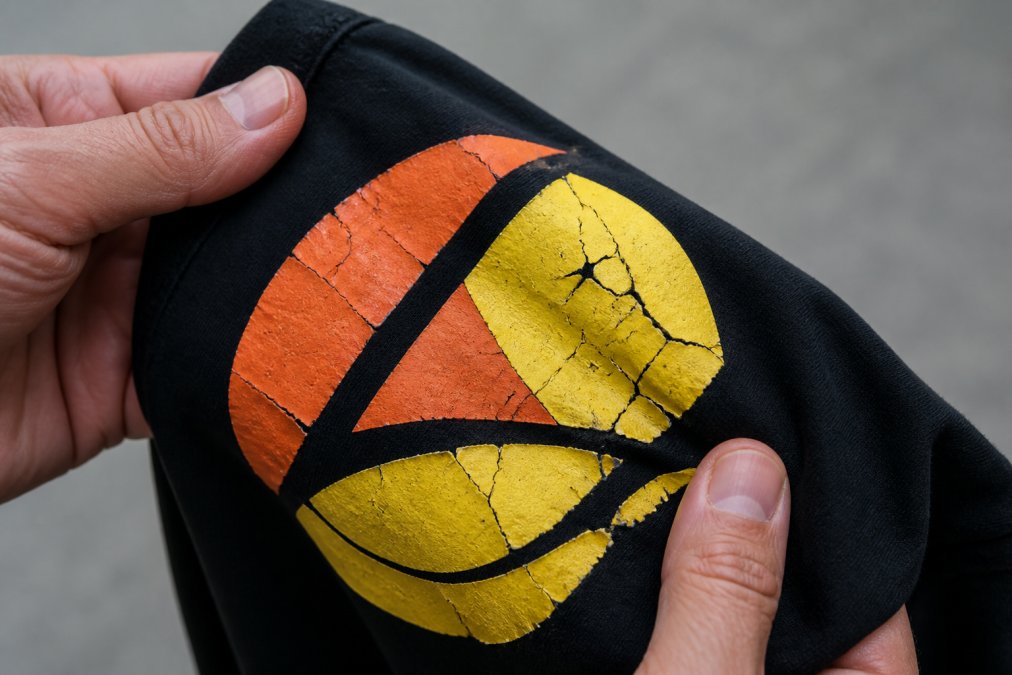
Under-Cured and Over-Cured Ink
Under-cured ink never fully bonds to the garment. The plastisol stays semi-liquid at the base, so the print sits on top of the fabric instead of locking into it, and washing pulls it apart layer by layer.
Over-cured ink fails the opposite way. Push plastisol past its cure window and the plasticizers burn off, leaving a stiff, brittle film that snaps instead of stretching. Under-cured prints feel tacky and wash out; over-cured prints feel hard and crack along fold lines.
Ink Thickness and Fabric Stretch
A heavy ink deposit cracks faster than a thin one. Thick layers of plastisol sit proud of the fabric and cannot flex when the garment stretches, so the print fractures at the stress points first. Low screen mesh counts lay down more ink per pass, which is why bold, heavy designs fail sooner than fine line work.
Fabric stretch matters just as much. A print on a 100% cotton tee behaves differently than the same print on a cotton/poly blend, because each substrate stretches at its own rate. When ink elasticity and fabric stretch fall out of sync, the ink loses.
How to Wash Screen Printed Shirts Without Cracking the Print
Wash screen printed shirts inside out in cold water on a gentle cycle, then air dry or tumble on low. Heat and agitation are what kill prints, not water alone. Turn the garment inside out, skip the dryer when you can, and your print will outlast the shirt.
Washing, Drying, and Detergent Best Practices
- Turn the shirt inside out before every wash
- Use cold water, never hot
- Choose a gentle or delicate cycle
- Skip bleach and fabric softener
- Air dry, or tumble on the lowest heat setting
- Wash printed items separately from zippers and hardware
Hot water and high dryer heat soften the ink film and let it stick to itself, which is how prints peel. Powder detergents that don't dissolve fully can also abrade the print surface over time.
Watch Out
The single most common mistake is tossing printed shirts in a hot dryer. One high-heat cycle can start the cracking that shows up weeks later, and the damage is permanent.
Screen Printing vs DTG Durability: Which Print Lasts Longer?
Screen printing generally outlasts DTG on the same garment when both are produced correctly, but the reason comes down to ink chemistry, not marketing. Plastisol is a suspension of PVC resin particles in plasticizer. During cure, the resin fuses into a continuous, rubbery film that stretches with the fabric. DTG inks are water-based pigment dispersions that cure by evaporating water and crosslinking a binder; the resulting film is thinner and less elastic, so it fatigues faster under repeated stretch.
That chemistry difference explains the practical durability gap:
| Factor | Screen Printing (Plastisol) | DTG (Water-Based) |
|---|---|---|
| Ink film | Thick, fused PVC film | Thin, binder-bound pigment |
| Cure mechanism | Heat fusion of resin and plasticizer | Water evaporation plus binder crosslinking |
| Elasticity | High, stretches with knit | Moderate, fatigues at fold lines |
| Best for | Bold designs, bulk orders | Detailed, full-color art |
| Wash durability | Very high | Moderate |
| Feel on fabric | Slightly raised | Soft, near-flat |
| Cracking risk | Low when cured right | Higher on stretch fabrics and high-stretch blends |
Water-based and discharge inks sit between the two. Water-based prints feel softer than plastisol but rely on the same binder chemistry as DTG, so they crack under the same conditions: over-stretch, under-cure, or a heavy deposit on a high-stretch fabric. Discharge inks actually bleach the garment dye rather than sitting on top, so they show almost no cracking, but they only work on dyeable cotton and cannot produce light colors on dark garments.
The takeaway: if longevity is the priority, screen printing with properly fused plastisol wins. If your design has photographic detail, DTG gets you there, provided the cure is dialed in and the garment is not a high-stretch blend. Match the ink system to the fabric and the wear pattern, not just to the artwork.
Heat Press Settings and Pressure: Getting the Cure Right
Correct curing depends on three variables working together: temperature, time, and pressure. Plastisol needs to reach its full cure temperature throughout the ink film, not just on the surface. Most plastisol formulations fuse in the 300-330°F range, and the ink must hold at that temperature for roughly 60-90 seconds. Water-based and DTG inks typically cure hotter and longer, often 320-360°F for 90-180 seconds, because the water has to leave the film before the binder can crosslink.
Those ranges are starting points, not universal settings. Ink manufacturers publish a cure window for each product, and the window is narrow: a plastisol rated for 320°F may under-cure at 300°F and scorch at 350°F.
Pro Tip
A common mistake is trusting the temperature dial alone. Verify actual ink temperature with a heat gun, a temperature probe, or a non-contact infrared thermometer, because platens drift and a reading that looks right on the display can be off by enough to under-cure the print. For plastisol, a simple stretch test after the print cools is a fast field check: if the ink film cracks when you pull the fabric, it is not fully fused.
Watch Out
Over-curing is just as damaging as under-curing. Push plastisol past its cure window and the plasticizers burn off, leaving a stiff, brittle film that snaps along fold lines. The print may look fine on delivery and crack within a few washes.
How to Fix Cracked Screen Print and Repair Minor Damage
You can repair minor cracked screen print damage at home, but understand the limits first. Small cracks and light peeling can be improved; a fully shattered print cannot be restored to new condition. The realistic goal is slowing further damage and making the crack less visible.
- Assess the damage. If the ink is flaking off in sheets, repair isn't practical. If it's hairline cracking, you have options.
- Clean the area. Wash and fully dry the garment so no detergent residue remains.
- Apply a fabric-safe adhesive. Use a product made for textiles, following its label instructions.
- Press with heat. A household iron on a low setting over a pressing cloth can re-bond minor lifting.
- Air dry completely. Give the repair 24 hours before wearing or washing.
Storage Conditions and Print Age: What Shortens Print Life
Print age matters as much as print quality. Ink film continues to lose plasticizers over time, so a shirt that sat in a hot warehouse for a year can crack faster than a fresh print from the same run. Storage conditions accelerate or slow that decline.
Key Takeaway
Two shirts from the same order can age very differently. The one stored in a hot garage will crack before the one kept in a climate-controlled closet, even though the print quality was identical on day one.
Choosing Custom Apparel That Resists Cracking
The garment you choose sets the ceiling on print durability. Fabrics with some polyester content stretch more predictably and hold ink films better than loosely knit cotton, and a tighter knit resists the mechanical stress that splits prints. For anything that will be washed weekly, build the print for the fabric, not the other way around.
Frequently Asked Questions
How to keep shirt print from cracking?
Wash the shirt inside out in cold water on a gentle cycle, and avoid fabric softener and bleach. Tumble dry on low or air dry completely. Proper curing during production is the most important factor: under-cured ink will crack no matter how carefully you wash. For screen printed and DTF shirts, following the care label and avoiding high heat extends print longevity significantly.
Does DTG printing crack?
DTG prints can crack if the ink is applied too thickly or if the garment is not properly pre-treated. DTG ink sits on top of the fabric fibers, so it is more prone to cracking on stretchy fabrics or when the print is heavy. Proper curing and limiting ink deposit help, but DTF transfers often hold up better on stretch fabrics because the adhesive bonds more flexibly.
Can you fix cracked print?
Minor cracking can sometimes be improved with a heat press or iron on low heat, which re-melts the ink and helps it re-bond to the fabric. Place parchment paper over the print and press for 10-15 seconds. This works best on small cracks and plastisol inks. Severe cracking or large missing areas usually cannot be repaired, and the garment may need to be replaced.
Is screen printing more durable than heat transfer?
Screen printing generally outlasts heat transfer because plastisol ink cures into the fabric and forms a flexible, durable bond. Heat transfer prints sit on top of the fabric and can peel or crack with repeated washing. However, DTF transfers with proper adhesive and curing can rival screen printing durability, especially on cotton and cotton blends.
Cracking prints are almost always a production or care problem, not bad luck, and both are solvable. If you need custom apparel that holds up through real wear, 2mepromo.com handles the printing, the artwork prep, and the fabric selection so your branded gear survives the wash cycle. From custom logo tees to full event kits, our team builds each order around how it will actually be used. Get started with 2mepromo.com and put your brand on apparel that lasts.
- Choosing a selection results in a full page refresh.
