Your cart is empty
Looks like you haven't added anything to your cart yet







Custom Event Display Solutions for Nonprofits
Table of Contents
- Why Your Nonprofit Needs a Cohesive Event Display Strategy
- Custom Event Display Solutions for Nonprofits: Types and Use Cases
- Custom Printed Table Covers for Conferences and Galas
- Portable Trade Show Displays for Charities on the Go
- Best Practices for Nonprofit Event Branding and Donor Recognition
- Budget, Storage, and Maintenance: What to Consider Before You Buy
- Conclusion: Build a Display Kit That Serves Your Mission
- Frequently Asked Questions
Last Updated: September 5, 2026
Nonprofits pour countless hours into fundraising strategy, donor outreach, and mission storytelling, yet many overlook the physical environment where those efforts come to life. The visual impression your organization makes at a gala, community fair, or conference directly shapes how attendees perceive your credibility and professionalism.
At 2mepromo.com, we help government agencies and small organizations build cohesive visual identities for their most important gatherings. This guide breaks down the display types that deliver the strongest return, the branding practices that build donor trust, and the practical logistics of budget, storage, and maintenance.
Why Your Nonprofit Needs a Cohesive Event Display Strategy
Scattered signage and mismatched tables communicate disorganization, undermining the trust you ask donors to place in your cause. A cohesive strategy ensures every visual element reinforces one clear message and one professional identity.
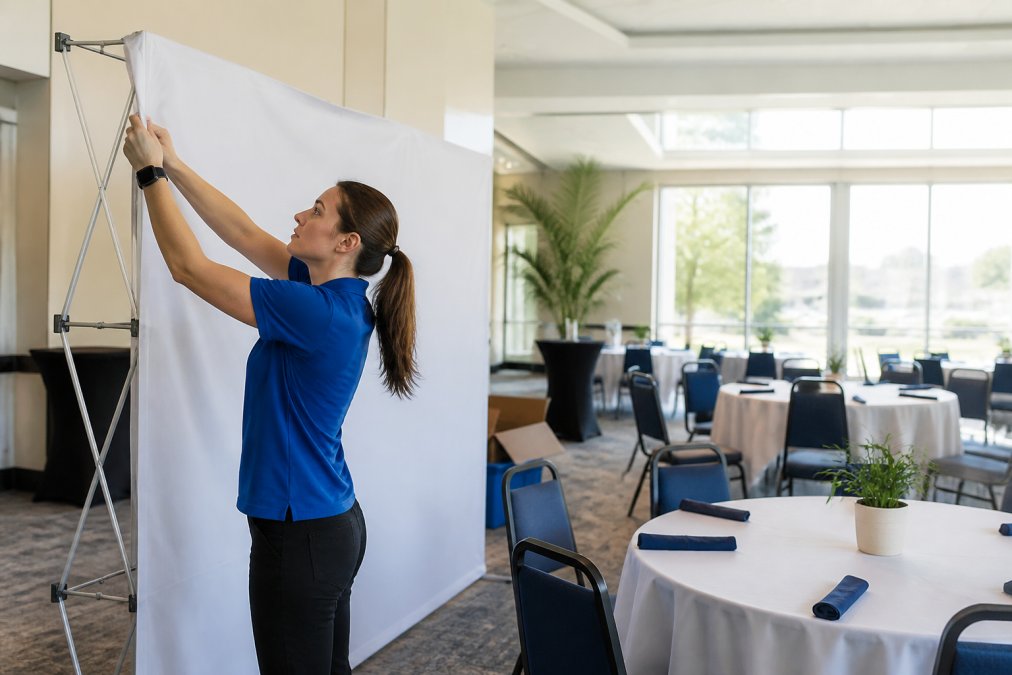
That consistency pays off in donor retention. People give to organizations they remember and trust, and a polished, unified presence makes your cause easier to recall when a follow-up appeal arrives.
Custom Event Display Solutions for Nonprofits: Types and Use Cases
The right display depends on your venue, audience, and goals. For indoor galas and award ceremonies, a striking backwall creates the focal point for the room and the backdrop for speeches. For outdoor events like charity 5Ks or county fairs, a canopy tent provides shelter while broadcasting your brand.
Fabric displays are the workhorse of the modern nonprofit kit. Tension fabric graphics offer a wrinkle-free, high-resolution surface that looks premium and packs down small. Modular display systems allow you to configure different sizes for different events. Invest in pieces that flex across your calendar, not single-use items that gather dust.
Backwall and Step-and-Repeat Displays for Photo Moments
A step-and-repeat backdrop, covered in your logo and mission hashtag, is one of the highest-ROI pieces a nonprofit can own. It creates a designated photo moment where board members, volunteers, and donors capture images they will share across their own social channels, extending your event visibility for days.
For larger stages, the 10 ft EZ Tube Straight Display assembles in about five minutes with no tools. The pillowcase-style graphic slides over the frame and zips shut, delivering a smooth, professional finish.

Canopy Tents for Outdoor Charity Events
Outdoor events demand durable banners and structures that can handle wind while still looking sharp. A custom canopy tent serves as your headquarters at a community fair, a registration point for a walk-a-thon, or a shade station at a volunteer recruitment drive.
Look for frames rated for wind, typically around 20-28 mph, and always secure your tent with weights even on calm days (the CDC).
Custom Printed Table Covers for Conferences and Galas
The table in front of you is prime real estate. It is where you collect email sign-ups, distribute brochures, and answer questions, so it should carry your branding as clearly as your backdrop. Custom printed table covers are one of the most cost-effective marketing tools available.
Full-color dye-sublimation printing on polyester tension fabric allows for edge-to-edge branding. For round tables at a donor luncheon, a full-wrap Round Table Throw delivers a clean, tailored look. For rectangular check-in tables, a fitted cover with a skirt hides clutter.
Portable Trade Show Displays for Charities on the Go
Many nonprofits operate with a small staff and no dedicated logistics team, so portability is a requirement. Portable displays must set up quickly, break down faster, and fit into a standard vehicle.
The RPL Fabric Counter pops up in minutes, features a foldable countertop and inner shelf, and packs into a travel bag. The Gopher Pop Up Counter expands in under ten seconds with hydraulic shocks and supports up to 42 lbs. For speaking engagements, a Pop Up Podium in a wheeled hard case gives your executive director a branded platform that travels easily.
Best Practices for Nonprofit Event Branding and Donor Recognition
Your displays should tell two stories: who you are and who you honor. Event branding is most effective when it is restrained and consistent.
Branding That Builds Trust Without Shouting
A common mistake is treating every display as a billboard. At a fundraising gala, your attendees are already there to support your cause; they do not need to be sold. Instead, your branding should create a sense of occasion. A large backwall behind the stage should feature your mission statement or a powerful image, not a list of every program you offer.
Consistency across all touchpoints is critical. If your logo is a specific shade of blue, ensure the dye-sublimation print matches your brand guidelines.
Donor Recognition: Making Sponsors Feel Seen
Donor recognition is a distinct discipline. A permanent lobby signage or wall mural in your office acknowledges major contributors year-round, but at events, recognition should be woven into the experience. When printing recognition walls, verify the spelling of every name twice; accuracy is a sign of respect.
For tiered sponsorship levels, consider a modular donor wall that allows you to swap out names for different events.
Timing matters for donor recognition. Announce new major gifts during the event, not after, so the donor feels the public acknowledgment in real time.
Accessibility and ADA Compliance: Designing for Every Attendee
Accessibility is a non-negotiable element of best practices. The Americans with Disabilities Act (ADA) sets standards for signage in public spaces, and designing with accessibility in mind is both a legal safeguard and a moral imperative.
Ensure wayfinding systems use high-contrast colors and large, readable type so all attendees, including those with low vision, can navigate your space independently. The ADA recommends a minimum contrast ratio of 70% between text and background colors (ada.gov).
Sans-serif fonts like Arial or Helvetica are generally easier to read at a distance than serif fonts. For body text on table tents or brochures, use a minimum font size of 12 points, and for wayfinding signs, use letters at least 2 inches tall for every 20 feet of viewing distance (section508.gov).
For attendees with hearing impairments, consider adding QR codes to your displays that link to a text version of your speech or a video with captions.
Watch Out
If your event is held in a venue that receives federal funding or is open to the public, your signage may be subject to ADA Title III requirements. Consult with your venue's accessibility coordinator or a signage professional who understands ADA guidelines before you finalize your display order.
Budget, Storage, and Maintenance: What to Consider Before You Buy
A common mistake is buying the cheapest option and replacing it every season. A higher upfront investment in durable fabric and aluminum framing pays off across multiple events.
| Display Type | Starting Price | Setup Time | Best For |
|---|---|---|---|
| Round Table Throw | $94.53 | Instant | Galas, donor luncheons |
| Pop Up Podium | $86.15 | Under 5 min | Speaking engagements, check-in |
| 10ft Custom Canopy Tent | $660.00 | 15-20 min | Outdoor fairs, 5Ks, community events |
| 10 ft EZ Tube Straight Display | $772.68 | ~5 min | Indoor backwalls, stages |
| 15ft. EZ Tube® Straight Fabric Display | $1,226.15 | ~10 min | Large galas, main stages |
The Hidden Cost of DIY Setup vs. Professional Installation
Many nonprofits assume that any display with a "pop-up" or "tool-free" claim can be handled by a volunteer with no training. That assumption often leads to bent frames, torn fabric, or a crooked backwall.

![[Prime] 10ft Custom Canopy Tent](https://cdn.shopify.com/s/files/1/0712/7492/2209/files/ONE-CHOICE-10ft-Aluminum-Canopy-Tent_GraphicPackage-WhiteTrim-01.jpg?v=1785099587)
For a single indoor gala, a two-person volunteer team can typically assemble a 10 ft EZ Tube Straight Display in about five minutes if they have practiced once. The risk is the tension fabric; pulling the pillowcase-style graphic over the frame requires a specific technique to avoid snagging the zipper or stressing the seam.
Professional installation services, often available through your print vendor or a local AV company, typically cost between $150 and $400 per event. If your event is in a union venue or convention center with strict labor policies, you may be required to use their in-house team regardless. Check your venue contract before you buy a display you cannot legally set up yourself.
For outdoor events, the calculus changes. A canopy tent rated for 20-28 mph winds still requires proper weighting. Sandbags alone are often insufficient on asphalt; you need auger-style stakes for grass or water-filled weights for hard surfaces.
Sustainability: Choosing Materials That Match Your Mission
For a nonprofit, the environmental impact of your display materials is a reflection of your values. Many commercial print vendors push vinyl banners because they are cheap and durable, but vinyl is difficult to recycle and often ends up in landfills.
Tension fabric displays made from recycled polyester are now widely available. These fabrics use yarn spun from post-consumer plastic bottles, and the dye-sublimation printing process uses water-based inks that are less harmful than solvent-based inks.
For outdoor banners, look for PVC-free vinyl alternatives or mesh fabrics that allow wind to pass through, reducing stress on grommets and extending the banner's life.
Storage: The Silent Killer of Event Displays
Storage is the silent killer of event displays. Fabric graphics should be rolled, not folded, to prevent creases that are difficult to remove. Most quality displays come with a hard case or travel bag; use them.
A practical storage system is more than just a closet. Assign one person on your team to be the "display keeper" who logs what is in each case, checks for damage after every event, and rotates stock. For canopy tents, never store them wet; a damp tent will develop mildew that is nearly impossible to remove.
Maintenance: Extending the Life of Your Investment
Regular maintenance is a small time investment that pays off in avoiding costly replacements. After each event, inspect all zippers, Velcro, and frame connections. A bent aluminum tube can often be straightened, but a cracked weld cannot be repaired inexpensively.
For digital displays, keep the screen firmware updated and clean the screen with a microfiber cloth.
Turnaround Time and Planning Your Calendar
Turnaround time matters. If you are planning for a county fair next month, confirm the production schedule before you order. Many fabric displays ship within two to three business days, but custom prototyping and proofing can add time, so build a buffer into your planning calendar. For a new design, allow at least two weeks from final proof approval to delivery.
A common pattern among successful nonprofits is to order their core display kit once every three to five years, then refresh only the fabric graphics for each new campaign. This keeps your branding current without replacing the expensive hardware.
Pro Tip
Before you buy, ask your print vendor for a sample swatch of the fabric and a test print of your logo. This will help you verify color accuracy and fabric texture before you commit to a full order.
Conclusion: Build a Display Kit That Serves Your Mission
Your event displays are a direct reflection of your organization's competence and care. Scattered, worn, or mismatched visuals undermine your message, while a cohesive, professional kit builds the trust that converts attendees into long-term donors.
At 2mepromo.com, we build custom event display solutions for nonprofits that prioritize durability, easy setup, and striking visual impact. Get started with 2mepromo.com and build a display kit that makes your mission impossible to ignore.
Frequently Asked Questions
What are the most cost-effective event display solutions for small nonprofits?
For small nonprofits, the most cost-effective approach is to invest in versatile, reusable pieces. A custom printed table cover, like our [Round Table Throw](https://2mepromo.com/products/round-table-throw-41ec10d1-aeba-470d-a54e-afd80d6b7181) starting at $94.53, transforms a basic table into a branded touchpoint. Pair it with a [Pop Up Podium](https://2mepromo.com/products/pop-up-podium-8d0db0f5-2e2a-4c24-8e56-2dd9e7f235e7) at $86.15 for a professional speaking area. These items are lightweight, pack down small, and can be used at conferences, galas, and community tabling events for years, making them a smarter investment than one-time-use banners.
How can custom signage increase donor engagement at charity events?
Custom signage increases donor engagement by creating a professional atmosphere and clearly communicating your mission. A branded step-and-repeat backdrop encourages attendees to take photos, which they often share on social media, extending your event's reach. Wayfinding signs help guests navigate auctions or dinner stations smoothly, improving their overall experience. When attendees feel the event is well-organized and visually compelling, they are more likely to stay longer, learn about your cause, and give generously.
What materials are best for reusable nonprofit event banners?
Dye-sublimated fabric is the best material for reusable nonprofit event displays. Unlike vinyl banners, fabric is wrinkle-resistant, lightweight, and can be washed and folded without cracking or fading. Tension fabric systems, like our EZ Tube displays, use a pillowcase-style graphic that slips over an aluminum frame. This design allows you to swap graphics for different campaigns while keeping the same hardware, which is a cost-effective and eco-friendly way to keep your nonprofit event displays fresh.
How do you design an event booth that aligns with nonprofit branding guidelines?
Start with your logo and mission statement as the visual anchors. Use your nonprofit's established color palette for the main graphics, but avoid clutter by reserving 30-40% of the display as open space. Include high-quality photos of your work to build emotional connection. For text, focus on a single, clear call-to-action like "Join Us" or "Donate Today." Finally, ensure your messaging is consistent from the table cover to the backdrop to reinforce brand recognition and donor retention.
This article was written using GrandRanker
- Choosing a selection results in a full page refresh.
