Your cart is empty
Looks like you haven't added anything to your cart yet






How to Implement Small Business Set Aside Promotional Items
Last Updated: November 9, 2026
Quick Summary
To implement a small business set aside for promotional items, first confirm your company is small under the NAICS code and size standard listed in the solicitation, then register in SAM. Track the set-aside designation on SAM.gov, since orders above the micro-purchase threshold may be reserved for small firms, and document your eligibility.
- Check the NAICS code and SBA size standard in each solicitation before bidding.
- Register your business in the System for Award Management (SAM) before submitting any quote.
- Orders between the micro-purchase and simplified acquisition thresholds are automatically set aside when two or more small businesses are expected to offer.
- Use SAM.gov alerts with keywords like promotional items to find new set-aside solicitations quickly.
- Confirm the funding source and ethics limits with the buyer before recommending any promotional product.
Table of Contents
- Why Set-Asides Matter for Promotional Item Purchases
- Confirm Your Small Business Set-Aside Requirements First
- Understand the Total Small Business Set-Aside FAR 19.5 Requirements
- Step-by-Step: Structuring a Promotional Item Set-Aside
- Finding Government Contracts for Small Businesses
- Choosing Small Business Promotional Products That Fit the Award
- Requesting a Quote for Your Next Set-Aside Order
- Frequently Asked Questions
Why Set-Asides Matter for Promotional Item Purchases
When a federal agency buys promotional items, it often has to set part of the work aside for small businesses through a small business set aside. That rule shapes who can bid, how the order is written, and how you should prepare. Many small business owners want government work but aren't sure where to begin.
A small business set aside is a purchase reserved for small businesses. Agencies use them to spread federal spending across more companies. For a promotional products vendor, that can mean a real opportunity, as long as you know the rules.
Procurement officers who buy branded outreach and event materials follow the same process as any other federal buyer. They need to confirm eligibility, price the job fairly, and document their choice. Understanding this helps you respond faster and with fewer mistakes.
Confirm Your Small Business Set-Aside Requirements First
Before you bid, check whether your business qualifies as small under the rules for the specific North American Industry Classification System (NAICS) code listed in the solicitation. Size standards are set by the U.S. Small Business Administration (SBA) (Table of size standards). Your revenue or employee count must fall under the limit for that code.
Here is a quick checklist to start:
- Find the NAICS code in the solicitation.
- Look up the size standard for that code on the SBA website.
- Compare your average annual receipts or employee count to the standard.
- Confirm your business is registered in the System for Award Management (SAM).
Many small businesses skip the size check and lose time. Verify it early so you know whether the set-aside applies to you.
Understand the Total Small Business Set-Aside FAR 19.5 Requirements
The Federal Acquisition Regulation (FAR) Part 19.5 is the rulebook contracting officers follow when they reserve work for small businesses (Subpart 19.5 - Small Business Total Set-Asides, Partial Set-Asides, and Reserves). For a promotional products vendor, knowing how that subpart works is the difference between reading a solicitation correctly and wasting a bid cycle. See FAR Subpart 19.5 Set-Asides for the full text.
Total vs. partial set-asides
A total set-aside reserves the entire acquisition for small businesses. A partial set-aside divides the requirement so small businesses compete for one portion and the remainder is acquired under full and open competition. FAR 19.502-3 governs partial set-asides, and it applies when the contracting officer determines a total set-aside is not feasible but a portion of the work can still be reserved.
The automatic vs. discretionary distinction
FAR 19.502-2 sets out the rule that most small vendors care about: acquisitions above the micro-purchase threshold and at or below the simplified acquisition threshold are automatically set aside for small businesses when there is a reasonable expectation of receiving offers from at least two responsible small business concerns. Above the simplified acquisition threshold, the set-aside becomes a discretionary decision the contracting officer documents after market research. The practical takeaway: the smaller the order, the more likely it is already reserved for you before you ever see it.
What the contracting officer must document
When a set-aside is used, the contracting file has to show the market research that supported the decision, the applicable NAICS code and size standard, and the rationale for choosing total versus partial. That file is what a bid protest or an audit reviews. Vendors who understand this can spot a weak set-aside decision, and can also make a stronger case for themselves by showing, in a capability statement or a quote, that they are a responsible small business able to perform.
The nonmanufacturer rule and promotional items
Under FAR 19.505, a nonmanufacturer must generally supply the product of a small business manufacturer to qualify for a set-aside. Confirm how this rule applies to the specific solicitation before you price the job.
Where the set-aside decision meets your bid
Read every solicitation for three signals: the NAICS code and size standard, the set-aside designation (total or partial), and any clause referencing FAR 19.5. Those three items tell you whether you are eligible, how much of the work is reserved, and which documentation the buyer will expect. Knowing the mechanics also lets you respond to a total set-aside with a cleaner, more competitive quote because you are not guessing at the buyer's process.
The table below condenses the main FAR 19.5 set-aside rules that vendors need to check on every solicitation.
| Rule | What it covers | Key point |
|---|---|---|
| FAR 19.502-3 | Partial set-asides | Used when a total set-aside is not feasible but part of the work can be reserved |
| FAR 19.502-2 | Set-asides between micro-purchase and simplified acquisition thresholds | Automatic when at least two responsible small businesses are expected to offer |
| Above simplified threshold | Discretionary set-asides | Decided by the contracting officer after market research |
| FAR 19.505 | Nonmanufacturer rule | A nonmanufacturer must generally supply a small business manufacturer's product |
| Contract file | Documentation required | Must show market research, NAICS code, size standard, and total or partial rationale |
Step-by-Step: Structuring a Promotional Item Set-Aside
Agencies that buy promotional products follow a clear sequence. Use these steps to organize your own bid or to understand what the buyer expects.
Step 1: Define the Requirement and Market Research
Start by stating what the agency needs. Quantity, product type, imprint details, delivery date, and budget all matter.
Then the buyer researches the market. Officers often check whether enough small vendors can deliver the order. If several can, a set-aside is likely.
Expected result: A written requirement that names the products, quantities, and delivery needs.
Step 2: Decide Between Total and Partial Set-Aside
Compare the order size and the number of qualified small businesses. If the market supports it, the buyer sets the full order aside. If not, it may split the work.
Watch out: Do not assume a set-aside applies just because an order is small. The decision depends on market research, not order size alone.
Step 3: Document the Set-Aside Decision
The contracting file must record why the set-aside was chosen. This is required for audit and for any later bid protest.
Expected result: A file that shows the market research, the size standard, and the reason for the set-aside.
Finding Government Contracts for Small Businesses
Most federal opportunities are posted on SAM.gov. Set up alerts using keywords such as "promotional items," "branded merchandise," and "event supplies" to see new solicitations quickly.
Look for these details in each listing:
- The NAICS code and size standard
- Whether the award is marked as a small business set-aside
- The closing date and any required certifications
- The delivery location and schedule
Many government agencies also buy through small business programs. Check whether the agency publishes forecasts of upcoming buys so you can plan ahead.
Choosing Small Business Promotional Products That Fit the Award
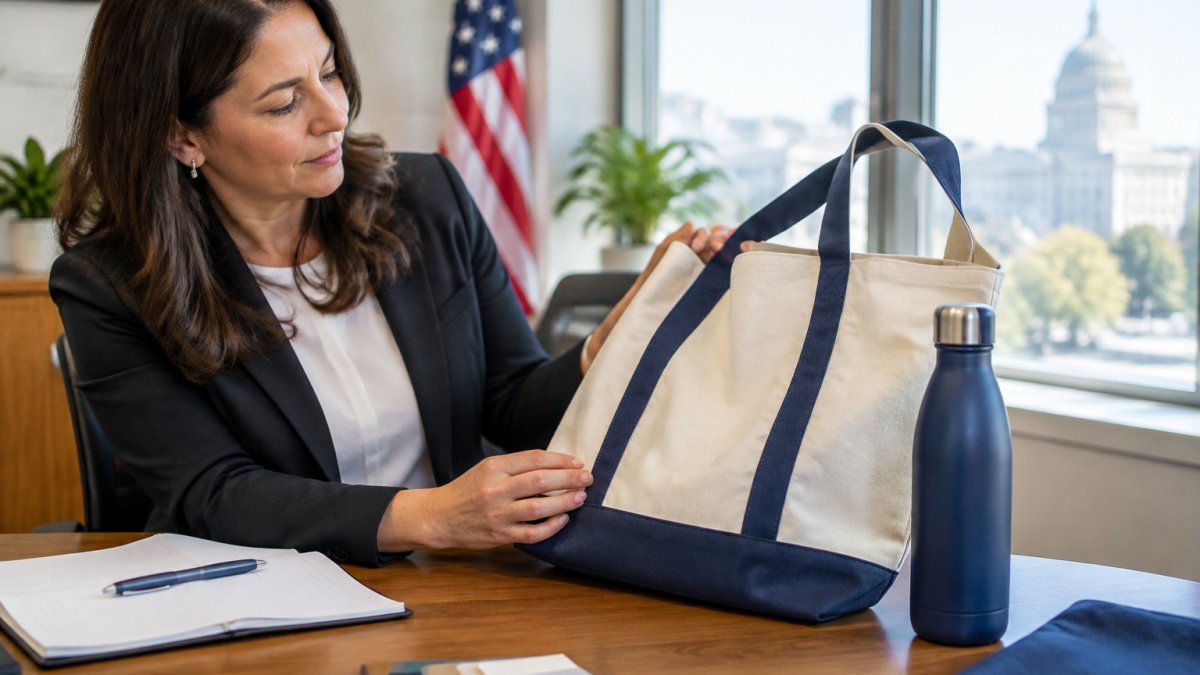
Selecting items an agency can accept depends on its funding, ethics, and sustainability rules, so confirm these before recommending a product.
Start with the funding source, not the product
Agency promotional purchases are usually funded from appropriated dollars tied to a specific program, outreach campaign, or event. Before you recommend a product, ask the buyer which appropriation funds the order and whether the items are for public outreach, employee recognition, or a recruiting event. Items tied to public outreach generally face fewer restrictions than items that could be read as personal gifts to federal employees. A common pattern is that buyers will not commit to a product until they have confirmed the funding line supports it.
Respect the gift and ethics rules
Federal employees are subject to standards of conduct that limit the value of gifts they may accept from outside sources. Promotional items distributed broadly at a public event are treated differently from items handed to an individual employee. When a buyer asks whether a particular item is permissible, the safe answer is to point them to their agency's ethics counsel rather than to guess. Vendors who understand this distinction build trust; vendors who promise "anything goes" create risk for the buyer.
Match products to the agency's green procurement posture
Some agencies operate under sustainability and green procurement directives. Ask the buyer whether one applies to the order.
A compliance checklist for the buyer
When you quote a promotional item for an agency event, walk the buyer through these questions so the order survives review:
- Which appropriation funds this order, and does it permit outreach materials?
- Is the item for broad public distribution or for individual employees?
- Does the agency have a sustainability directive that applies to this purchase?
- Does the item carry the agency's approved logo and branding standards?
- Is the quantity justified by the expected audience size?
Products that fit these criteria
Here are a few 2mepromo.com products that suit agency outreach and event needs:
- 150 Customized Cotton Shopping tote - Full color logo ($498.00): Made from 100% cotton sheeting with reinforced stress points. Learn more at 2mepromo.com.
- 200 White Barrel Ball Point Click Pen ($175.00): A bulk pen order with a one-location, one-color imprint. Learn more at 2mepromo.com.
- 200 Custom pens - one color imprint on barrel ($115.00): Bulk-packaged pens with German black ink and a 1mm tip. Learn more at 2mepromo.com.
- Translucent Chip Clip with Magnet ($338.00): A 2" x 3" clip with a magnet on the back that sticks to file cabinets, refrigerators, and other magnetized surfaces. Learn more at 2mepromo.com.
Choose items that match the event, the budget, the agency's branding rules, and the funding source behind the order.


Promotional product prices from 2mepromo.com
150 Customized Cotton Shopping tote $498.00
200 White Barrel Ball Point Click Pen $175.00
200 Custom pens - one color imprint $115.00
Translucent Chip Clip with Magnet $338.00
Requesting a Quote for Your Next Set-Aside Order
When you request a quote from a supplier, give them the same details the agency gave you. Include quantities, imprint areas, colors, delivery date, and shipping location. This prevents surprises later.
If you are still choosing products, our buyer's guide to custom employee awards can help you compare options before you ask for pricing.
Ask every vendor for:
- A written quote in USD with all costs listed
- Proof approval steps and timing
- Shipping details and delivery timing
- Sample images or physical samples when possible
Compare quotes side by side, and confirm each vendor's small business status before you submit.
Frequently Asked Questions
What is a 100% small business set-aside?
A 100% small business set-aside is a federal acquisition in which the contracting officer restricts competition to small business concerns only. Under FAR 19.5, the agency must reasonably expect at least two responsible small businesses to submit offers at fair market prices, and the award must be made to a small business. For a promotional item purchase, the buyer confirms the vendor is registered as small under the applicable NAICS size standard before issuing the order, then records the basis for the set-aside in the contract file.
What is the nonmanufacturer rule for small business set-asides?
The nonmanufacturer rule allows a small business that is not the actual manufacturer of a product to qualify for a set-aside if it supplies the product of a small business manufacturer, and the product is not manufactured by a large business. Promotional items such as printed pens or custom tote bags are often sourced this way, so the vendor should confirm its status and the manufacturer's size before the award. Buyers should verify the vendor's representation in the solicitation.
Can a small business use the set-aside program for branded merchandise?
Yes. Branded merchandise such as custom pens, tote bags, and chip clips can be procured under a small business set-aside when the purchase falls within a set-aside and the vendor meets the size standard. For example, an order for 200 custom pens priced at $115.00 or 150 printed totes at $498.00 can be awarded to a qualifying small business if the agency documents the set-aside decision and the vendor represents its status.

- Choosing a selection results in a full page refresh.
