Your cart is empty
Looks like you haven't added anything to your cart yet







7 Best Fabrics for Government Field Uniforms
Last Updated: October 24, 2026
Quick Summary
The best fabrics for field uniforms are cotton twill for dry climates, poly-cotton blends for all-around daily wear, ripstop for tear-prone work, performance polyester for heat and humidity, and canvas or denim for heavy-duty use. Hazard roles need FR-treated blends instead of standard fabric.
- Cotton twill breathes well and holds embroidery cleanly but shrinks and dries slowly when wet.
- Poly-cotton blends range from 50/50 to 65/35, with higher polyester improving wrinkle resistance.
- Ripstop's reinforced grid weave stops small tears from spreading on brush and equipment work.
- Performance polyester wicks moisture and dries fast, suiting hot and humid field roles.
- Confirm garment-level certification and laundering compatibility before buying any protective garment.
Table of Contents
- Quick Comparison: 7 Fabrics for Field Uniforms
- 1. Cotton Twill: The Comfort Standard for Dry Climates
- 2. Polyester Cotton Uniform Fabric: The All-Around Workhorse
- 3. Ripstop Fabric for Uniforms: Tear Resistance Where It Counts
- 4. Breathable Work Uniform Fabric for Heat and Humidity
- 5. Canvas and Denim: Heavy-Duty Options for Rough Terrain
- 6. Hazard Protection: Flame, Arc, and High-Visibility Requirements
- 7. Uniform Fabric Care Instructions That Extend Service Life
- Frequently Asked Questions
Quick Comparison: 7 Fabrics for Field Uniforms
Choosing the best fabrics for government field uniforms comes down to matching fiber, weave, and weight to the job. At 2mepromo.com, we see procurement teams weigh durability against breathability, then check whether the fabric meets the safety and appearance standards their crews work under. Below, we compare seven options and explain where each one earns its place. For the full picture, see our guide to outfitting government agency staff.
| Fabric | Best For | Key Strength | Main Trade-off |
|---|---|---|---|
| Cotton twill | Dry climates, office-to-field roles | Comfort and breathability | Shrinks and wrinkles |
| Poly-cotton blend | All-around daily wear | Balance of cost and durability | Moderate breathability |
| Ripstop | Rough terrain, tear-prone work | Tear resistance | Stiffer hand |
| Performance polyester | Heat and humidity | Moisture wicking | Less natural feel |
| Canvas | Heavy-duty outdoor work | Abrasion resistance | Heavy and slow to dry |
| Denim | Rugged field crews | Long service life | Slow drying |
| FR-treated blends | Hazard environments | Flame and arc protection | Higher cost |
1. Cotton Twill: The Comfort Standard for Dry Climates
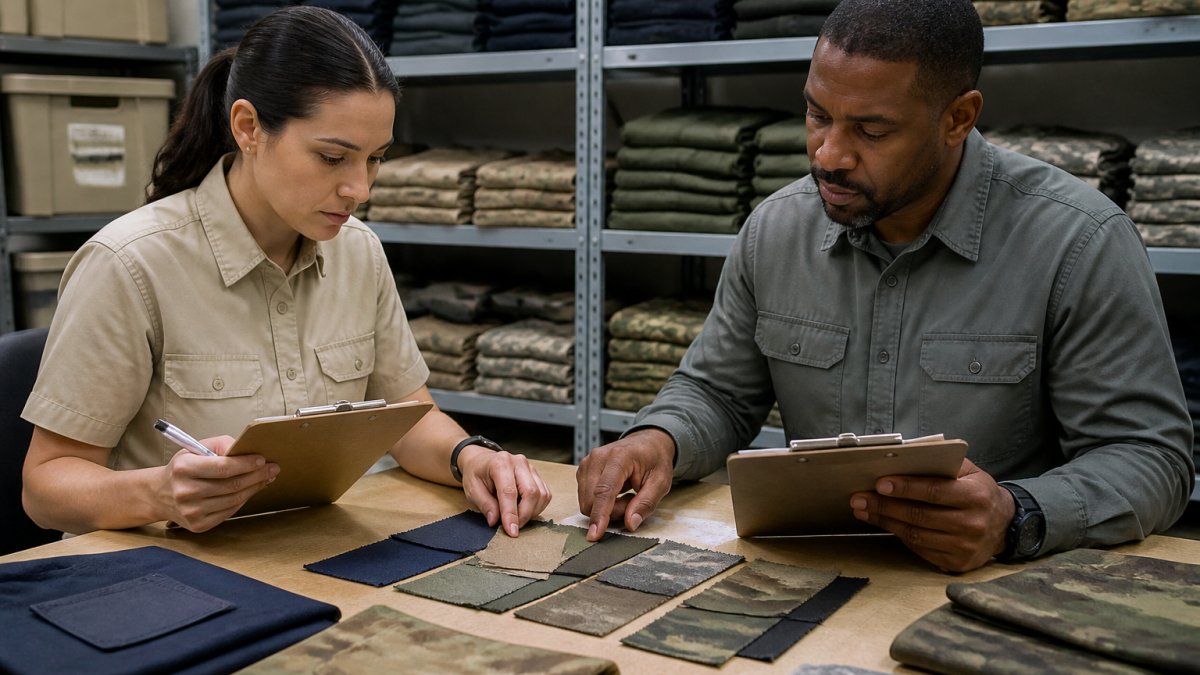
Cotton twill is a durable woven fabric with a diagonal rib pattern that resists everyday wear. It breathes well, feels soft against the skin, and holds up through repeated laundering, which makes it a common pick for dry, mild climates.
Field crews in arid regions tend to favor cotton twill because it stays comfortable through long shifts. The fabric accepts dye and embroidery cleanly, so agency insignia and logos reproduce sharply. A common mistake is ordering untreated cotton for wet climates, where it absorbs water and dries slowly.
Pros and Cons of Cotton Twill
- Pros: Breathable, comfortable, holds color and embroidery well, affordable
- Cons: Shrinks without pre-shrinking, wrinkles easily, dries slowly when wet
Watch out: unwashed cotton twill can shrink enough after the first few laundry cycles to throw off sizing across a whole order. Confirm pre-shrunk stock before you buy.
2. Polyester Cotton Uniform Fabric: The All-Around Workhorse
Polyester cotton uniform fabric blends natural and synthetic fibers to balance comfort with durability. Most blends land between 50/50 and 65/35 poly-cotton, and the ratio drives how the garment performs.
Higher polyester content improves wrinkle resistance and colorfastness. Higher cotton content improves breathability. For mixed field and office roles, a mid-range blend usually wins. For teams weighing fabric quality trade-offs, our guide on how to choose quality custom apparel walks through the details.
Blend Ratios That Matter
- 65/35 poly/cotton: Best for stain resistance and easy care
- 50/50: Balanced breathability and durability
- Cotton-dominant: Softer feel, more wrinkles
3. Ripstop Fabric for Uniforms: Tear Resistance Where It Counts
Ripstop fabric for uniforms uses a reinforced grid weave that stops small tears from spreading.
For crews working around brush, fencing, and equipment, ripstop earns its keep. Our snag resistant polo is a practical starting point for teams that keep catching sleeves on equipment.
4. Breathable Work Uniform Fabric for Heat and Humidity
Breathable work uniform fabric moves moisture away from the skin so crews stay cooler in heat and humidity. Performance polyester and engineered knits lead here, wicking sweat and drying fast.
For hot-weather field roles, look for moisture-wicking finishes and UV protection. Our LST520 Sport-Tek Women's Posi-UV Pro Polo, at $14.99, offers a UPF 50 rating and moisture wicking in a 4-ounce polyester interlock. The ST520 men's version carries the same specs. If your crews rotate between sun and shade, breathable performance polos are worth a look.

5. Canvas and Denim: Heavy-Duty Options for Rough Terrain
Canvas and denim are the heavyweights of uniform fabric. Both use dense cotton weaves built for abrasion resistance and long service life, and both suit rough terrain where lighter fabrics wear through.
Canvas, often a plain or basket weave, takes the most punishment. Denim, a twill, offers similar toughness with more flexibility. Neither dries quickly, and both feel heavy in summer heat. Reserve them for cooler climates and roles where durability outranks breathability.
6. Hazard Protection: Flame, Arc, and High-Visibility Requirements
Hazard protection is where fabric choice becomes a safety decision, not a comfort one. Standard uniform fabrics, cotton twill, poly-cotton, ripstop, canvas, are not substitutes for protective clothing, and treating them as such is the most common procurement error in field uniform programs. The right approach is to start from the hazard assessment your agency has already performed, then match the fabric and garment certification to the exposure.
LST520 Sport-Tek ® Women's Posi-UV® Pro Polo DTF →
When standard uniform fabric is not enough
Three hazard categories routinely require role-specific protective clothing rather than general field fabric:
- Flame and thermal hazards. Workers near flammables, combustibles, or molten material need flame-resistant (FR) garments. FR fabrics are typically treated cotton, modacrylic blends, or aramid blends engineered to self-extinguish rather than melt and drip. Untreated polyester is a poor choice near flame because it can melt and adhere to skin.
- Arc flash and electrical exposure. Electrical workers and utility crews need arc-rated (AR) clothing. Arc-rated garments carry an arc rating expressed in calories per square centimeter (cal/cm²), and that rating must meet or exceed the incident energy of the task. Arc ratings are not the same as flame resistance, a garment can be FR without being arc-rated, so confirm both when the task requires both.
- High-visibility work. Traffic control, roadside inspection, and emergency response roles need high-visibility garments using fluorescent background fabric with retroreflective trim. Visibility garments are typically certified to a performance class, and the class must match the roadway speed and work zone configuration.
What to verify before you buy
Procurement teams should confirm four things for every protective garment:
- The standard the agency cites. Confirm the garment's certification matches the exact standard referenced in the solicitation, not a similar-sounding one.
- The rating, not just the label. Ask for the arc rating in cal/cm² or the FR test documentation, and keep it on file.
- Garment-level certification. A fabric may be rated while the finished garment, with its trim, thread, and closures, is not. Confirm the finished garment carries the certification.
- Laundering compatibility. FR and AR performance degrades with improper washing. Confirm the care instructions the manufacturer provides and that they fit your laundry contract.
Watch Out
Never substitute a non-rated fabric to save cost. A lower unit price on an uncertified garment is not a savings, it is an uninsured liability, and it will not survive an audit.
High-visibility fabric specifics
High-visibility garments combine a fluorescent background, typically fluorescent yellow-green or fluorescent orange-red, with retroreflective trim. The background fabric is usually a lightweight polyester or poly-cotton knit or woven, and the reflective trim is the performance-critical component.
For roles that combine hazards, for example, roadside electrical work, the garment must satisfy every applicable requirement at once. Confirm with the agency safety officer before assuming one garment covers multiple hazards.
7. Uniform Fabric Care Instructions That Extend Service Life
Uniform fabric care is a budget line, not a housekeeping detail. The purchase price of a field uniform is only part of its cost; laundering, repair, and replacement frequency usually determine the lifecycle cost of a program. Care instructions protect appearance, performance, and, for protective garments, certification.
Care rules by fabric type
- Cotton twill and canvas. Wash in cold or warm water and tumble dry low. Expect some shrinkage on untreated cotton; pre-shrunk stock reduces sizing drift across an order. Canvas benefits from air-drying to preserve shape.
- Poly-cotton blends. Wash warm, tumble dry low, and skip fabric softener. Softener coats the fiber and reduces stain release and wicking performance over time.
- Performance polyester and engineered knits. Wash cold, turn inside out, and air-dry to preserve moisture management and UPF performance. Avoid high heat, which can degrade wicking finishes.
- Ripstop. Wash warm and tumble dry low. Inspect the grid weave at high-abrasion points, knees, elbows, cuffs, for fraying before it becomes a tear.
- FR and AR garments. Follow the manufacturer's care instructions exactly. Avoid bleach and fabric softener, which can degrade flame resistance. Confirm that your laundry contract uses the correct cycle and detergent for protective garments.
Inspection and repair intervals
A simple inspection routine extends service life more than any single care tip:
- After every wash: check seams, reflective trim, and closures.
- Monthly: inspect high-abrasion points, knees, elbows, cuffs, and pocket edges, for thinning or fraying.
- Before each season: review the full inventory for garments that no longer meet appearance or safety standards.
Field repair matters for government crews working away from base. A small rip in ripstop or canvas can be patched in the field with a fabric patch and adhesive, but protective garments should be removed from service rather than field-repaired if the repair affects the certified performance.
Pro Tip
Track replacement frequency by fabric type across a season. A fabric that costs more per unit but lasts two seasons often beats a cheaper fabric replaced every year, and the data makes the next procurement easier to justify.
Lifecycle cost considerations
When comparing fabrics, weigh purchase price against service life, laundering cost, repairability, and replacement frequency. Recycled-fiber options are increasingly available in performance polyester and blends, and they can fit sustainability goals without sacrificing the durability field crews need. Ask suppliers for service-life expectations and care requirements in writing so the comparison is apples to apples.
For deeper guidance on durable apparel choices, see our article on durable custom apparel for staff uniforms. Proper laundering and inspection extend service life and keep lifecycle costs down.
Frequently Asked Questions
Which fabrics are best for durable field uniforms?
For most government field roles, a poly-cotton blend in the 65/35 range offers the best balance of durability and comfort. It resists shrinking and wrinkling better than pure cotton while staying softer than 100% polyester. For high-abrasion work like grounds maintenance, ripstop nylon or cotton canvas lasts longer. Match the fabric to your crew's actual daily tasks rather than picking one fabric for the whole agency.
Are ripstop fabrics suitable for field uniforms?
Yes. Ripstop fabric for uniforms uses a reinforced grid weave that stops small tears from spreading, which matters for crews working around brush, fencing, and equipment. The trade-off is that ripstop can feel less soft against the skin than cotton, so check the hand feel before ordering for full-day wear.
How do you choose a breathable fabric for field uniforms?
Moisture-wicking finishes help in humid conditions. For hot climates, a breathable work uniform fabric such as a lightweight polyester interlock or a poly-cotton blend outperforms heavy canvas, which traps heat during long outdoor shifts.
How should field uniform fabric be cared for?
Follow uniform fabric care instructions on the label: wash in cold or warm water, avoid fabric softener on moisture-wicking pieces because it clogs the fibers, and tumble dry low. Turn garments inside out to protect printed logos. Stain-release finishes on poly-cotton polos need prompt washing to work. Inspect seams and high-wear areas monthly, and retire garments once fading or thinning affects professional appearance.
What fabric blend is best for government field uniforms?
A 65/35 poly-cotton blend is the most common choice for government field uniforms because it balances durability, cost, and comfort. Higher polyester content improves wrinkle resistance and colorfastness; higher cotton content improves breathability. For flame or arc hazards, specify fabrics that meet the applicable NFPA standard rather than relying on a generic blend.
Matching the right fabric to each field role takes time, and getting it wrong shows up fast in the field. 2mepromo.com helps government agencies and small businesses order custom apparel with tailored solutions, personalized branding, and high-quality, custom-made products. We handle everything from staff uniforms to event signage, so your crews look consistent and professional. Get started with 2mepromo.com and outfit your field teams in fabrics built to last.

- Choosing a selection results in a full page refresh.
